Repair settling foundation issues demand immediate attention from experienced professionals who understand St. Louis soil conditions and proven stabilization methods. When your home's foundation has settled unevenly, you're facing more than cosmetic cracks — you're dealing with a structural stability problem that worsens exponentially without intervention. Our St. Louis foundation repair team specializes in settled foundation repair using engineered piering systems designed specifically for Missouri's expansive clay soil and Karst geology. We've served homeowners across the St. Louis metro area for over two decades, delivering permanent settling foundation repair solutions with transferable warranties that protect your investment and restore your home's structural integrity.
Signs Your Foundation Has Settled
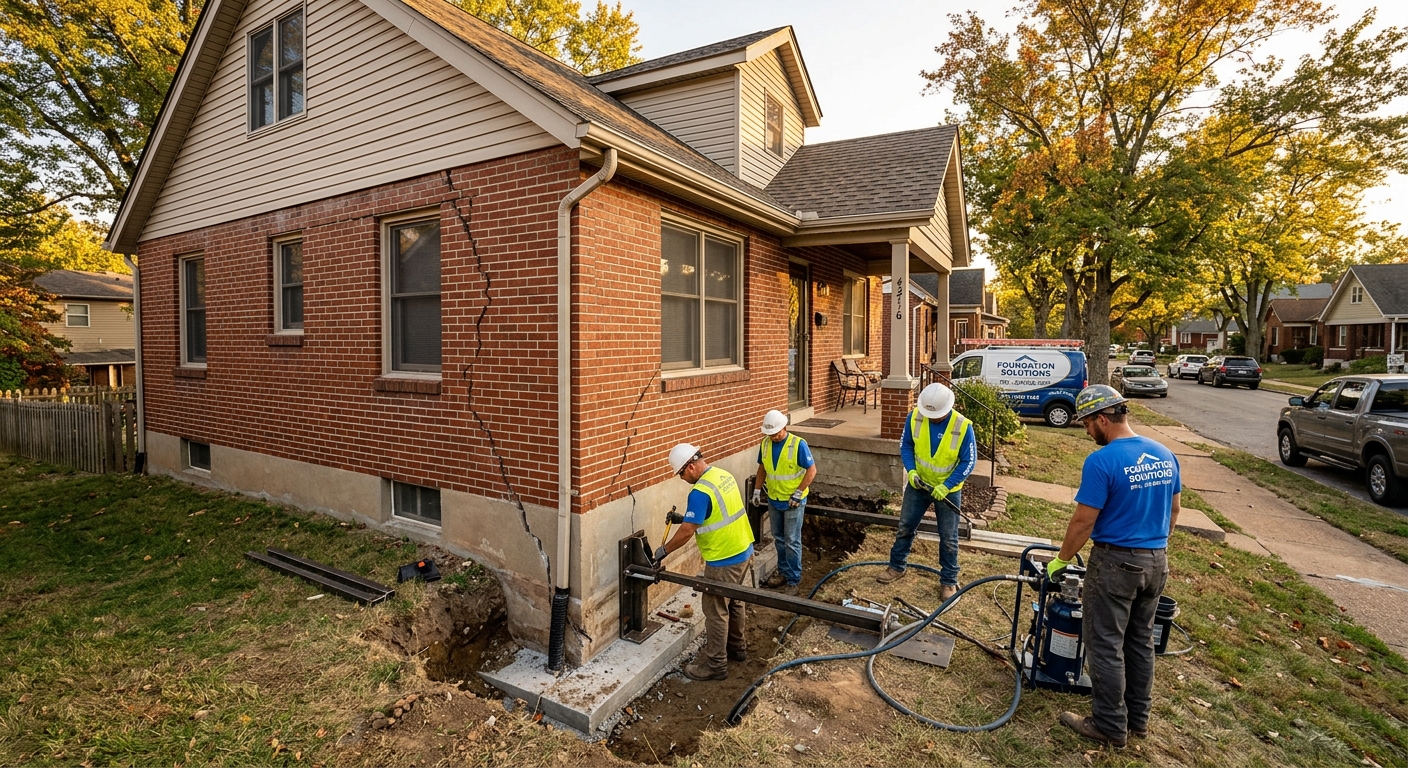
Settled foundation repair begins with accurate diagnosis. Your home sends clear warning signals when foundation settlement has progressed beyond normal aging. Most homeowners first notice interior symptoms — doors that suddenly stick, cracks appearing above window frames, or floors that feel uneven when walking through certain rooms. These visible signs indicate your foundation has moved, but determining whether that movement requires professional repair depends on understanding the difference between acceptable settlement and critical structural displacement.
Foundation settlement occurs in every home to some degree, but the pattern and magnitude determine whether you're facing a minor monitoring situation or an urgent repair scenario. A foundation that settles uniformly by a quarter-inch across the entire footprint rarely causes problems. A foundation experiencing differential settlement — where one corner drops two inches while another section remains stable — creates the structural stress that manifests as the cracks, separations, and alignment issues you're noticing throughout your home.
- Diagonal cracks extending from door and window corners at 45-degree angles
- Gaps between walls and ceilings or walls and floors that weren't present at move-in
- Exterior brick veneer showing stair-step cracking along mortar joints
- Windows and doors that no longer close properly or have visible gaps when closed
- Floors sloping noticeably toward one section of the home — often detectable by placing a marble on the floor and watching it roll
If you're observing multiple symptoms simultaneously, your foundation has likely settled enough to warrant professional assessment. Contact our team at (314) 798-9554 for a comprehensive foundation inspection that measures the exact degree of settlement and determines the appropriate repair method for your specific situation.
How to Measure Foundation Settlement — When 1/4 Inch Becomes Critical
Foundation repair contractors use precise elevation surveys to measure settlement across your home's footprint. The industry standard for repair intervention is differential settlement exceeding one-quarter inch over a 15-foot span. That seemingly small measurement becomes structurally significant because it indicates your foundation is moving unevenly — the type of settlement that generates stress concentrations and progressive damage. A qualified foundation inspector uses a laser level or transit to establish a baseline elevation, then measures multiple points around your foundation perimeter and at interior load-bearing walls.
The measurement that matters most is differential settlement — the difference in elevation between the highest and lowest points of your foundation. A home with uniform settlement of half an inch typically shows no cracking or distress because all components settled together. That same home with half an inch of differential settlement — where one corner dropped while another stayed level — will exhibit significant cracking and structural stress. Most St. Louis homes requiring settling foundation repair show one to three inches of differential movement, though we've corrected foundations with six inches or more of displacement in severe cases.
Differential Settlement vs. Uniform Settlement — What Your Cracks Mean
Understanding the difference between differential and uniform settlement helps you interpret the cracks and distortions you're seeing. Uniform settlement happens when your entire foundation lowers evenly into the soil — imagine a perfectly level table settling straight down. This type of settlement rarely causes structural damage because every part of your home moves together. The doors, windows, walls, and roof system all shift as a unit, maintaining their relationships to each other. Cracks from uniform settlement typically appear as minor hairline separations that don't widen or grow over time.
Differential settlement creates the foundation problems that demand repair. This occurs when sections of your foundation settle at different rates or different amounts — one corner drops two inches while the opposite corner remains stable, or the middle of your foundation settles while the perimeter stays level. Differential settlement forces your home's structural frame to bend and twist, concentrating stress at specific points and generating the characteristic damage patterns homeowners recognize as foundation problems. The cracks you're seeing — especially diagonal cracks wider at one end than the other — directly indicate differential settlement is actively stressing your home's structure.
Warning Signs That Your Foundation Needs Immediate Repair
Certain foundation settlement symptoms demand immediate professional response rather than continued monitoring. If you notice cracks wider than one-quarter inch, especially cracks that appear to be growing or changing over weeks and months, your foundation settlement is active and progressive. Active settlement means the underlying cause — typically soil shrinkage or consolidation — continues to worsen, and delaying repair allows exponentially more damage to accumulate throughout your home's structure.
Gaps between your chimney and house exterior signal severe differential settlement, as the chimney's independent foundation settles at a different rate than your main foundation. Floors sloping more than one inch over ten feet create trip hazards and indicate significant structural displacement. Water pooling against your foundation where it previously drained away suggests settlement has changed your home's grading, creating conditions that accelerate further foundation problems. Any combination of these severe symptoms warrants immediate evaluation — call our foundation repair team at (314) 798-9554 to schedule an emergency structural assessment.
Foundation Settlement Repair Methods in St. Louis
Settling foundation repair in St. Louis relies primarily on engineered piering systems that transfer your home's weight from unstable surface soil to competent bearing strata deep underground. The two dominant methods — push piers and helical piers — both accomplish the same fundamental goal: they bypass the expansive clay soil causing settlement and anchor your foundation to stable soil or bedrock that won't shift with moisture changes. The repair method your contractor recommends depends on your specific soil conditions, the weight loads requiring support, and the depth to stable bearing soil beneath your property.
Modern foundation repair technology has evolved far beyond the mud jacking and temporary shoring methods used decades ago. Today's piering systems carry 50-year warranties because they create permanent solutions by addressing the root cause — unstable foundation support — rather than treating surface symptoms. A properly engineered settled foundation repair system stops ongoing settlement immediately and often allows controlled lifting to restore your foundation toward its original elevation, closing cracks and realigning doors and windows in the process.
- Push pier systems driven to bedrock or dense soil using your home's weight as driving force
- Helical piers screwed into clay soil until reaching specified torque resistance indicating stable bearing capacity
- Slab jacking for concrete slab settlement supplementing structural pier work
- Combination approaches addressing both perimeter foundation walls and interior slab sections
- Engineered bracket systems distributing loads and allowing future adjustment if needed
Every foundation settlement pattern requires customized repair design. Our structural engineers evaluate your soil report, measure differential settlement across your foundation, calculate structural loads, and specify the exact pier type, depth, spacing, and capacity needed to permanently stabilize your foundation. This engineering-first approach ensures your repair solves the problem completely rather than providing temporary improvement that fails within years.
Push Pier Systems — Load Transfer Below Unstable Soil
Push pier foundation repair uses steel pier sections driven through unstable soil until reaching bedrock or dense load-bearing strata. The installation process leverages your home's own weight — hydraulic rams push each pier section down using the foundation itself as counter-resistance, driving the pier deeper until it refuses further penetration because it's encountered soil or rock capable of supporting your home's structural loads. Once piers reach refusal depth — typically 15 to 30 feet below grade in the St. Louis area — contractors attach foundation brackets and hydraulically lift to transfer your home's weight onto the new deep foundation system.
Push piers excel in St. Louis foundation applications because they don't rely on surface soil friction or bearing capacity. The expansive clay soil that caused your original foundation settlement sits entirely above the pier's bearing point, meaning future soil shrinkage and swelling can't affect your foundation's stability. The system's hydraulic lift capability also allows contractors to actively raise settled foundation sections, often recovering one to two inches of elevation loss and dramatically reducing crack widths and structural distortions throughout your home.
Helical Piers — Engineered Stability for Clay Soil Foundation Repair
Helical pier systems feature steel shafts with welded helical bearing plates that function like giant screws threading into soil. Installation equipment rotates each helical pier into the ground while monitoring torque resistance — when the torque reaches engineered specifications, the pier has engaged sufficient soil volume to carry your foundation's weight safely. Helical piers work exceptionally well in St. Louis clay soil because clay's cohesive properties create excellent friction and bearing resistance when engaged by the helical plates' large surface area.
Foundation engineers often specify helical piers for lighter structural loads, new construction applications, or situations where installation vibration must be minimized. The screw-in installation process generates far less noise and vibration than push pier driving, making helical piers ideal for settled foundation repair in occupied homes or properties with sensitive adjacent structures. Helical pier systems also allow installation at angles to address lateral soil movement or to reach stable soil zones that aren't directly beneath the failing foundation section.
Slab Jacking and Mud Jacking — Supplemental Foundation Repair Options
Slab jacking — also called mud jacking or concrete lifting — addresses settlement of concrete floor slabs, sidewalks, driveways, and garage floors. This repair method pumps a flowable grout mixture through small holes drilled in the settled concrete, filling voids beneath the slab and hydraulically lifting the concrete back toward level. While slab jacking effectively repairs concrete flatwork settlement, it doesn't provide the permanent foundation stabilization that piering systems deliver for structural foundation settlement.
Many St. Louis foundation repair projects combine piering for perimeter foundation walls with slab jacking for interior floor slabs. This combination approach makes sense because the mechanisms causing settlement differ — perimeter foundations settle when exterior soil shrinks or consolidates, while interior slabs often settle when poorly compacted fill soil beneath the slab compresses over time. Using the right repair method for each component ensures comprehensive, long-lasting results. Our foundation specialists assess both your structural foundation and concrete slabs during inspection to determine if combination repair delivers the best outcome for your specific settlement pattern.
How Structural Engineers Choose Your Foundation Repair Method
The foundation repair method selection process begins with detailed site investigation and structural analysis. A qualified structural engineer examines your foundation type (crawl space, basement, or slab-on-grade), documents settlement patterns and measurements, reviews soil reports or orders new soil borings, calculates structural loads that require support, and determines the depth to competent bearing soil. These data points combine to indicate which repair method will perform best for your specific conditions and provide the longest-lasting solution.
Soil conditions drive much of the decision-making process. Properties with bedrock at shallow depths — common in parts of the St. Louis metro area with limestone geology — often benefit from push piers that can be driven to rock refusal quickly. Sites with deep clay deposits but no accessible bedrock may favor helical piers sized to engage sufficient clay volume for reliable bearing capacity. Load magnitude also matters — heavily loaded foundation sections supporting multi-story construction or concentrated roof loads require larger capacity piers than lightly loaded single-story wall sections. Your engineer balances these variables to specify a repair system that stops settlement permanently while optimizing cost-effectiveness for your project scope.
What Causes Foundation Settlement in St. Louis
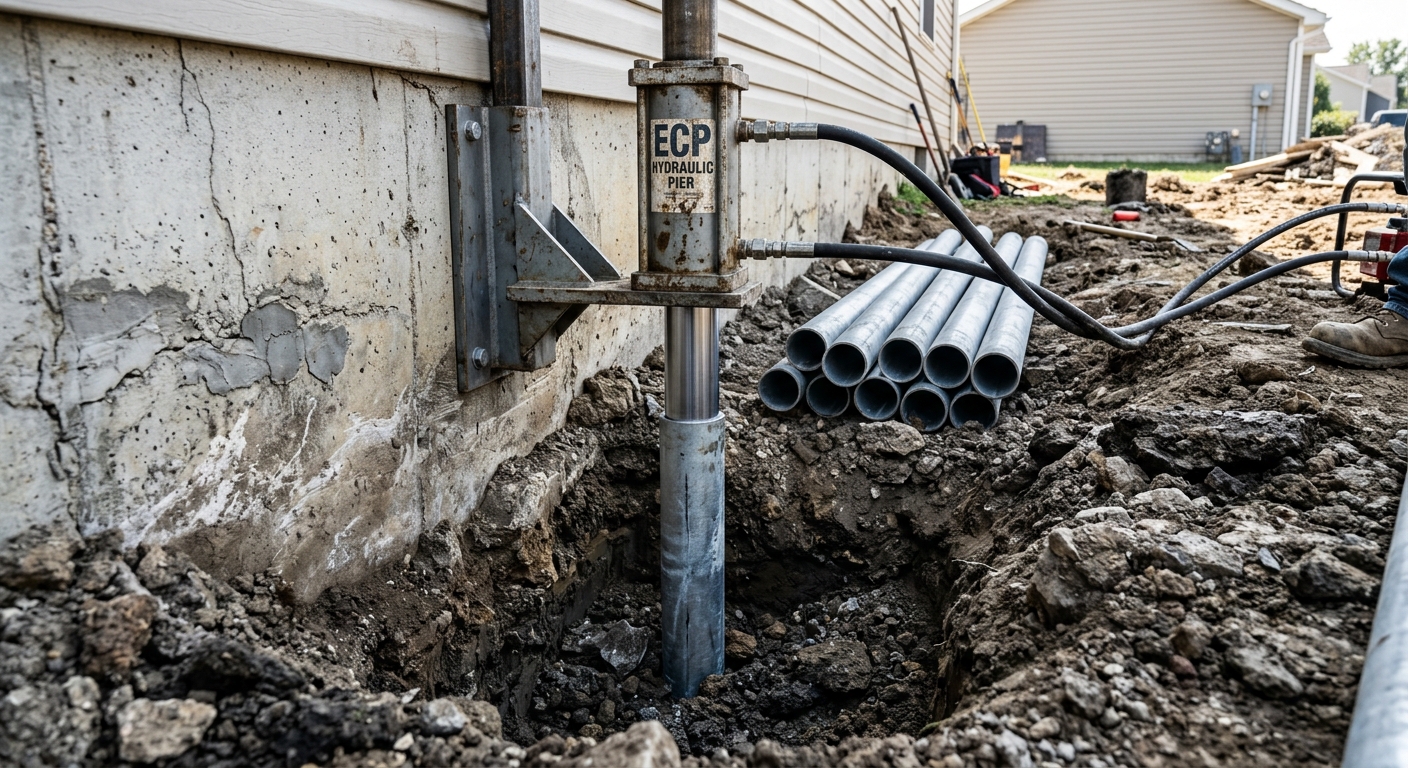
Foundation settlement in the St. Louis metropolitan area stems primarily from the region's expansive clay soil composition and the dramatic moisture fluctuations those soils experience through seasonal weather cycles. Understanding why your foundation settled helps explain why professional repair using engineered piering systems provides the only permanent solution — surface treatments can't address the underlying soil behavior that created the problem. The soil beneath St. Louis homes undergoes constant volume changes as moisture content rises and falls, creating the conditions that allow foundations to settle unevenly when soil support becomes inadequate.
Three geological and environmental factors dominate foundation settlement causation in our region. Expansive clay soil that shrinks dramatically when dry creates the single most common settlement mechanism. Moisture fluctuations driven by St. Louis's drought-flood weather cycles cause repetitive soil volume changes that progressively destabilize foundation support. Karst geology featuring underground limestone dissolution creates void spaces that occasionally allow sudden settlement or even sinkhole formation in susceptible areas. Every settled foundation we repair traces back to one or more of these three root causes.
- Clay soil particles expanding up to 10% when saturated and shrinking proportionally during drought periods
- Seasonal moisture cycles causing repetitive soil movement that loosens soil structure over years
- Limestone bedrock dissolution creating voids that allow overlying soil to settle into cavities
- Poor drainage concentrating water against foundation perimeters and saturating support soils
- Mature tree roots extracting massive soil moisture volumes during growing season and causing localized soil shrinkage
Most foundation settlement develops gradually over years or decades as these mechanisms progressively weaken soil support. Occasionally, triggering events like severe drought or exceptionally heavy rainfall accelerate settlement that was developing slowly, causing homeowners to suddenly notice symptoms that actually represent the culmination of long-term soil changes. Regardless of the timeline, professional settled foundation repair must address these soil-related causes by transferring foundation loads to stable strata that won't experience future movement.
Expansive Clay Soil — Missouri's #1 Foundation Settlement Culprit
St. Louis sits atop extensive deposits of expansive clay soil that exhibits extreme volume change characteristics based on moisture content. When these clay soils absorb water, the clay particles swell — increasing soil volume by five to ten percent and generating tremendous upward pressure against foundations and slabs. When clay soil dries out during hot, dry periods, the clay particles shrink as water molecules leave the crystal structure, causing the soil to contract and pull away from foundation walls. This shrink-swell cycle creates the classic foundation settlement pattern where sections of foundation supported by dried, shrunken clay drop lower while other sections remain stable.
The clay soil problem becomes particularly severe during extended drought periods when soil moisture drops three to six feet below the surface. Deep soil drying causes foundation settlement that persists even when surface soil later rehydrates, because the dried clay beneath your foundation has consolidated and compacted into a smaller volume that can't simply expand back to its original configuration. This irreversible consolidation explains why foundation settlement typically doesn't reverse when rain returns — the settlement becomes permanent, requiring piering repair to restore foundation support and prevent further structural damage as the weakened soil continues to shift through future moisture cycles.
Moisture Fluctuations and St. Louis Drought-Flood Cycles
St. Louis weather patterns create perfect conditions for foundation settlement through extreme moisture fluctuations. The region experiences periodic severe droughts followed by intense rainfall periods, subjecting foundation soils to dramatic wetting and drying cycles that progressively destabilize soil structure. The 2023 drought-to-flood transition exemplified this pattern — the St. Louis area recorded its driest summer in decades, followed by spring rains that delivered months of normal precipitation in weeks. Foundation repair contractors across the metro area reported a 40% increase in emergency stabilization calls as these conditions triggered widespread settlement in homes where soil support had been gradually weakening for years.
Repetitive moisture cycling damages soil structure cumulatively. Each shrink-swell cycle slightly rearranges soil particles, creating small voids and loosening the soil matrix. Over years and decades, this repetitive movement transforms relatively dense, competent support soil into loosened material with reduced bearing capacity. Eventually, the weakened soil can no longer adequately support your foundation's weight, and settling foundation repair becomes necessary to bypass the damaged soil zone entirely and anchor your home to deeper, stable strata unaffected by surface moisture changes.
Karst Geology and Sinkhole Risk in the St. Louis Metro Area
Portions of the St. Louis metropolitan area sit above Karst geology — landscape formed by limestone bedrock dissolution. When slightly acidic groundwater moves through limestone, it slowly dissolves the rock, creating underground cavities, voids, and channelways. In some areas, these voids grow large enough that overlying soil eventually collapses into the cavity, creating a sinkhole. More commonly, small-scale limestone dissolution creates irregular bedrock surfaces with solution cavities that allow soil to gradually settle into voids, producing foundation settlement that appears similar to clay shrinkage settlement but stems from a completely different geological mechanism.
Foundation settlement caused by Karst geology often exhibits sudden onset rather than the gradual progression typical of clay shrinkage. A homeowner may notice minimal symptoms for years, then observe rapid crack development and structural distortion over weeks or months as soil finally collapses into an underlying void. Areas west of St.
Frequently Asked Questions
Why Should I Consider Foundation Settling Repair?
Foundation settling repair in St. Louis prevents minor issues from becoming catastrophic structural failures. Ignoring settling leads to cracked walls, jammed doors and windows, uneven floors, and plumbing damage. Early repair typically costs $3,000–$8,000, while delayed intervention can exceed $25,000 as damage spreads throughout your home. St. Louis soil conditions—expansive clay that swells and shrinks—accelerate foundation movement, making prompt professional assessment critical to protecting your property value and family safety.
When Does My Foundation Need Repairing?
Your St. Louis foundation needs immediate repair if you notice diagonal cracks wider than a quarter-inch, doors that no longer close properly, gaps between walls and ceilings, or floors that slope noticeably. Stair-step cracking in exterior brick and water pooling near your foundation after Missouri rains indicate urgent problems. Horizontal cracks or bowing basement walls require emergency evaluation. Schedule a professional inspection within 48 hours of discovering these warning signs to prevent accelerated deterioration and costlier repairs.
Why Is My Foundation Settling?
St. Louis foundations settle because our expansive clay soil shrinks during dry periods and swells when saturated, creating unstable support conditions. Poor initial compaction during construction, inadequate drainage directing water toward your foundation, large tree roots extracting moisture unevenly, and plumbing leaks all contribute to settling. Homes built on fill dirt or near slopes face higher risk. The Mississippi River valley's soil composition makes foundation movement more common here than in regions with stable bedrock closer to the surface.
Expert Foundation Repair: What To Expect?
Professional foundation repair in St. Louis begins with a comprehensive inspection using laser levels and soil analysis to determine settlement patterns. The repair process typically involves installing helical piers or steel push piers beneath your foundation to reach stable soil layers, then hydraulically lifting the structure back to level. Most residential repairs take three to five days, with minimal landscape disruption. Expect detailed documentation, engineered solutions with transferable warranties, and building permit coordination. Reputable contractors provide lifetime warranties on structural components and labor.
Is DIY Foundation Repair Possible?
DIY foundation repair is extremely risky and typically fails in St. Louis because settling requires precision engineering and specialized hydraulic equipment. Surface-level fixes like epoxy injection or masonry patches address symptoms without correcting underlying structural movement, wasting money while damage continues. Professional repairs use load-bearing piers driven 15–30 feet deep to stable soil—impossible without commercial equipment and soil analysis. Missouri building codes require licensed contractors for structural foundation work. Attempting DIY repairs voids future warranty claims and reduces resale value when improper methods are discovered during home inspections.
What Can Cause Foundation Settling?
Foundation settling in St. Louis stems from soil moisture changes, poor drainage, tree root activity, and construction defects. Our region's expansive clay loses volume during drought and swells during wet seasons, creating movement cycles that stress foundations. Gutters dumping water beside your foundation, negative yard grading, broken sewer lines, and mature trees within 20 feet all contribute. Poorly compacted fill soil, inadequate footer depth, and foundations poured during freezing temperatures cause premature settling. Identifying the specific cause determines the most effective repair strategy.
How Can I Tell If The Foundation Is Settling?
You can identify foundation settling through visual inspection inside and outside your St. Louis home. Interior signs include cracks radiating from door and window corners, floors that feel uneven or slope toward one area, doors that swing open or closed independently, and separation between walls and ceiling molding. Outside, check for stair-step cracks in brick veneer, tilting chimneys, gaps where porches meet the main structure, and basement walls leaning inward. Use a marble or ball—if it consistently rolls toward one area, settling has created noticeable slope.
Is Foundation Settling A Common Issue?
Foundation settling is extremely common in St. Louis due to our challenging soil composition and climate patterns. The American Society of Civil Engineers estimates that 60 percent of homes built on expansive clay soil experience some foundation movement during their lifespan. St. Louis sits atop heavy clay layers that react dramatically to moisture changes, making foundation issues more prevalent than in areas with sandy or rocky substrates. Older neighborhoods in South St. Louis, Webster Groves, and Clayton see higher rates because construction standards evolved significantly after 1980.
How Much Does Settled Foundation Repair Cost in St. Louis?
Settled foundation repair in St. Louis typically ranges from $4,000 to $12,000 depending on severity and home size. Minor settling affecting one corner may cost $3,500–$5,000, while whole-house leveling with multiple pier installations runs $10,000–$20,000. Factors affecting price include pier type (helical versus push piers), number of piers required, accessibility, soil conditions, and structural damage repairs. Most contractors offer free inspections and detailed quotes. Financing options are widely available, and addressing settling early prevents exponentially higher costs from progressive structural damage.
Do You Serve All St. Louis Metro Areas for Foundation Repair?
We provide settling foundation repair throughout St. Louis City, St. Louis County, St. Charles County, and surrounding Missouri communities including Clayton, University City, Kirkwood, Webster Groves, Florissant, Chesterfield, and O'Fallon. Our service area extends to Illinois metro east locations like Belleville, Collinsville, and Edwardsville. Travel fees rarely apply within a 40-mile radius of downtown St. Louis. We maintain fully stocked service vehicles and can typically schedule inspections within 24–48 hours regardless of your location in the greater metropolitan area.
Book your free foundation inspection
Tell us what you are seeing and where the home is. The inspection is free, there is no obligation, and you get a written estimate showing the repair method, the number of piers or anchors and the total before anything is scheduled.