Epoxy crack injection cost in St. Louis typically ranges from $300 to $800 per crack, depending on length, depth, and accessibility. When you discover a foundation crack threatening your basement's integrity, understanding professional repair pricing helps you budget for permanent waterproofing before water damage escalates. Our certified injection specialists serve St. Louis, Clayton, University City, and the wider St. Louis County area with transparent pricing and proven foundation repair solutions that restore structural stability and stop leaks for good.
Foundation Crack Epoxy Injection — Cost & Pricing Breakdown
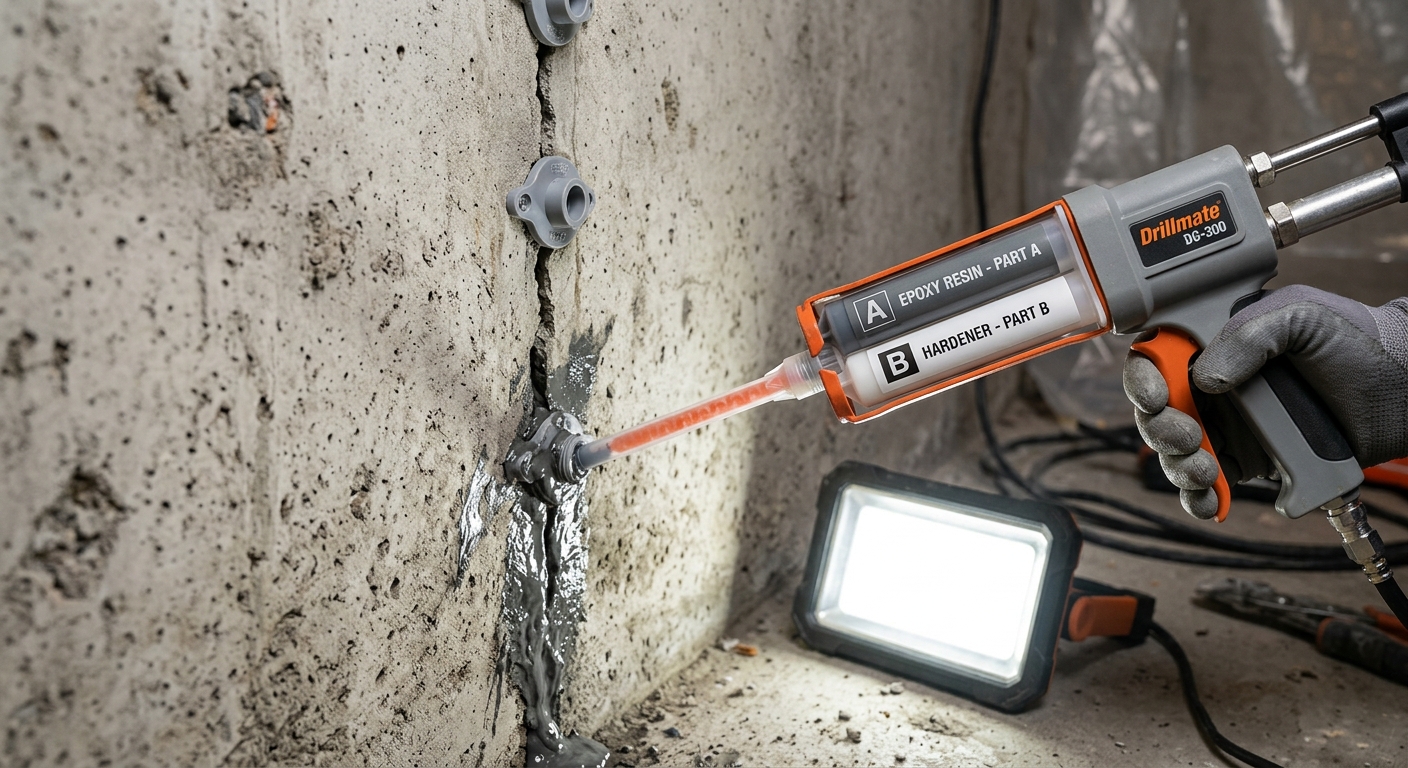
Foundation crack epoxy injection delivers the most cost-effective structural repair for dormant cracks in basement walls and concrete foundations. Professional injection services in the St. Louis market follow a pricing model based on linear footage, crack complexity, and material requirements. You'll receive a detailed estimate after a free inspection that measures the full extent of damage and identifies any hidden propagation behind finished walls.
Per-Linear-Foot Epoxy Injection Pricing in St. Louis
St. Louis foundation contractors charge $30 to $50 per linear foot for professional epoxy crack injection, with most residential repairs falling between 10 and 30 feet of total crack length. A typical vertical basement wall crack measuring 15 feet costs approximately $450-$750 to repair with low-viscosity structural epoxy. Pricing factors include:
- Crack width and depth — hairline cracks under 1/8 inch require less epoxy than wider structural failures
- Wall thickness — 8-inch poured concrete walls use less material than 10-inch foundation walls
- Injection port spacing — standard 8-12 inch intervals vs. dense 4-6 inch spacing for complex cracks
- Access challenges — exterior excavation or interior obstructions that require additional labor
- Material selection — structural-grade epoxy costs more than standard formulations but delivers superior bond strength
Your contractor measures the entire crack path, including any crack propagation that extends beyond the visible surface damage. Call (314) 798-9554 for a same-day measurement and written quote.
Minimum Service Charge & Multi-Crack Discounts
Most St. Louis foundation repair companies enforce a minimum service charge of $400-$600 to cover mobilization, equipment setup, and the packer system installation required for pressurized injection. This minimum applies even if your crack measures only 6-8 feet, making per-foot pricing less relevant for single small repairs. However, multi-crack properties benefit from volume pricing — repair three or more cracks in one visit and many contractors reduce per-foot rates by 15-25%. The hydraulic pressure equipment and injection ports used in professional repairs justify this minimum investment, especially compared to the $5,000-$15,000 cost of interior water damage if leaks continue untreated.
Factors That Increase Epoxy Crack Injection Cost
Several conditions specific to St. Louis foundations escalate repair costs beyond standard per-foot pricing. Expansive clay soil in the region creates hydrostatic pressure that can push repaired cracks open again, requiring carbon fiber reinforcement ($800-$1,200 additional) to prevent re-cracking. Horizontal cracks indicate serious structural stress and often require both epoxy injection and exterior drainage correction, doubling total project costs. Winter repairs face longer cure time requirements — low temperatures slow the curing agent reaction, adding 24-48 hours to project timelines and occasionally requiring heated enclosures for proper bonding. Finished basements require careful drywall removal and restoration, adding $200-$400 to access the crack from the interior surface.
Waterproofing Epoxy Injection — How It Stops Foundation Leaks
Waterproofing epoxy injection creates a permanent hydrophobic barrier that bonds directly to concrete at the molecular level, preventing water infiltration through foundation cracks even under extreme hydrostatic pressure. Unlike surface sealants that coat the visible crack face, professional injection forces low-viscosity epoxy through the entire wall thickness, filling voids and micro-fissures from the exterior face to the interior surface. This complete saturation stops leaks that gravity-fed DIY products miss entirely.
Hydrophobic Bonding & Injection Port Verification
Professional-grade structural epoxy forms a hydrophobic chemical bond with concrete that repels water molecules while maintaining flexibility for minor thermal movement. Technicians install injection ports every 8-12 inches along the crack path, then pump epoxy at 40-60 PSI until material flows from adjacent ports — visual confirmation that the entire crack depth has filled completely. This verification step eliminates the guesswork of surface sealing, where you never know if epoxy penetrated the full wall thickness or just coated the visible crack.
Why Surface Sealants Fail — Pressurized Injection Advantage
Surface sealants and retail epoxy kits fail because they rely on gravity to draw material into cracks, achieving only 1-2 inches of penetration in an 8-10 inch foundation wall. The remaining crack depth stays open, allowing water to migrate through the wall and reappear as dampness or active leaking during heavy rain. Pressurized injection uses hydraulic pressure to overcome concrete density and fill the entire crack void, including the critical exterior face where groundwater first enters. Professional equipment delivers consistent 40+ PSI injection pressure — 20 times the force of gravity-fed consumer products.
Waterproofing Warranty Coverage & Re-Leak Protection
Reputable St. Louis foundation contractors back waterproofing epoxy injection with 5-10 year transferable warranties covering re-leak events at the injection site. Warranty terms typically exclude new cracks caused by ongoing foundation movement or settlement, but protect you against injection failure or incomplete crack filling. Read warranty language carefully — the best protection specifies free re-injection if water reappears through the original crack, not just prorated material replacement. This warranty coverage transfers to new homeowners if you sell within the coverage period, preserving property value and buyer confidence.
Epoxy Injection Foundation Repair — St. Louis Soil & Climate Considerations
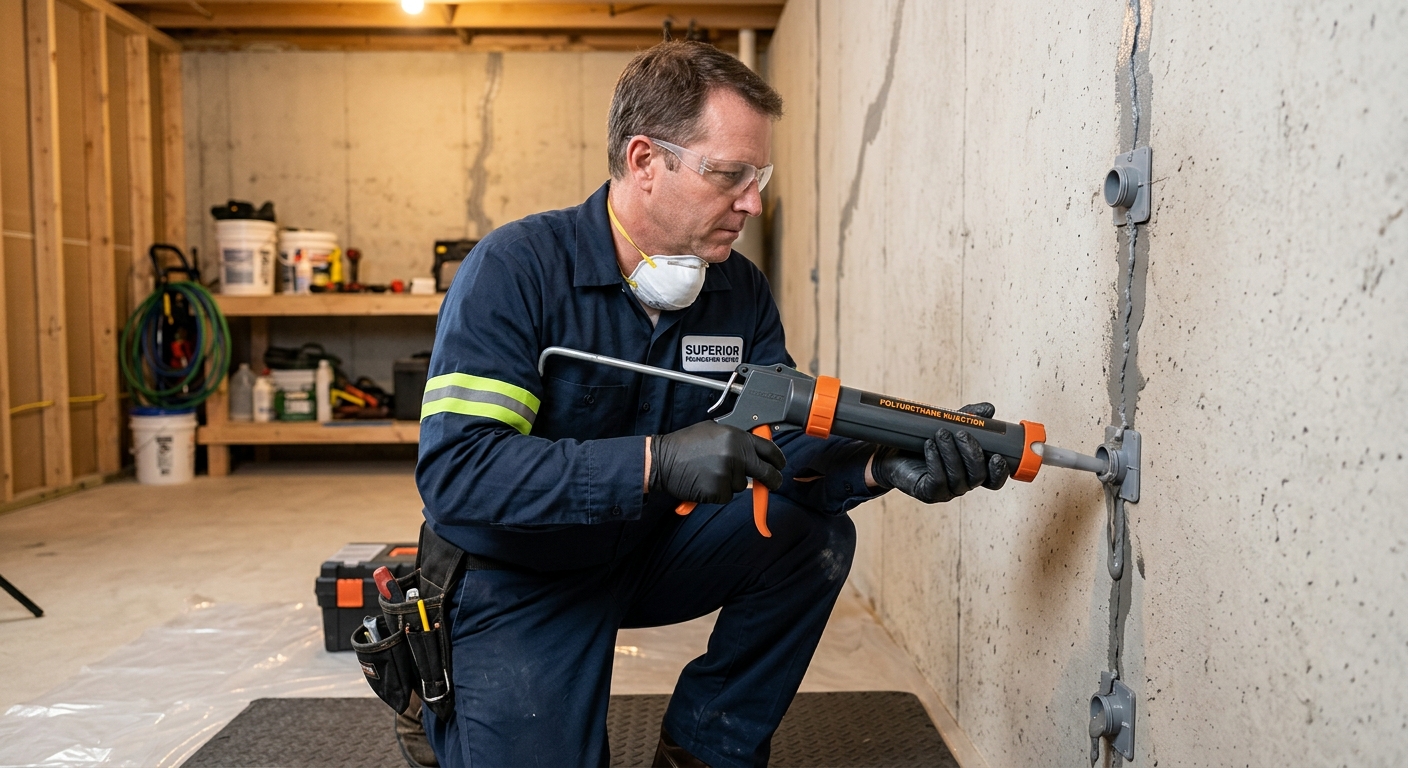
Epoxy injection foundation repair in St. Louis demands specialized knowledge of local soil behavior and seasonal temperature extremes that affect both crack formation and repair longevity. The region's expansive clay soil and freeze-thaw cycles create unique stress on basement walls that generic repair methods often fail to accommodate. Contractors experienced in St. Louis foundations adjust injection techniques, material selection, and reinforcement strategies to match local conditions.
Expansive Clay Soil Pressure & Freeze-Thaw Cycles
St. Louis sits on expansive clay soil that swells up to 10% when saturated and shrinks during dry periods, exerting 8,000-12,000 pounds per square foot of lateral pressure on foundation walls. This wet-dry cycle creates the vertical and diagonal cracks that homeowners discover after heavy spring rains. Freeze-thaw cycles compound the damage — water enters hairline cracks, freezes and expands overnight, then thaws and allows deeper water penetration the next day. Professional epoxy injection stops this cycle by creating a waterproof seal that prevents initial water entry, eliminating the freeze-expansion mechanism that widens cracks every winter.
Local Building Codes & Inspection Requirements
St. Louis County and City building codes require foundation repairs that restore structural integrity to meet International Residential Code standards for crack width and bond strength. While epoxy injection itself rarely requires permits for minor cosmetic repairs, structural cracks wider than 1/4 inch may trigger inspection requirements depending on wall location and load-bearing status. Licensed contractors familiar with local code enforcement know when inspections apply and document repairs with engineer certifications when needed — critical for future home sales when buyers request foundation repair records.
Cure Time in St. Louis Winter Conditions
Low-viscosity structural epoxy achieves 90% of full bond strength within 24 hours when temperatures stay above 50°F, but St. Louis winter repairs face slower curing timelines. December through February basement temperatures often dip to 40-45°F, extending cure time to 48-72 hours before repairs reach maximum strength. Professional contractors account for this delay when scheduling cold-weather repairs, sometimes using heated blankets or faster-curing formulations to maintain 24-hour project timelines. Never attempt DIY injection in freezing conditions — epoxy viscosity increases dramatically below 40°F, preventing proper flow through crack voids and resulting in incomplete fills that leak again in spring.
Concrete Epoxy Sealing — Professional Application Process
Concrete epoxy sealing follows a precise multi-step protocol that ensures complete crack saturation and maximum bond strength restoration. Professional application requires specialized equipment, material handling expertise, and quality verification steps that DIY approaches cannot replicate. Understanding this process helps you evaluate contractor capabilities and recognize cutting corners that lead to repair failures.
Injection System Setup & Packer Placement
Technicians begin concrete epoxy sealing by grinding or wire-brushing the crack face to remove loose concrete, efflorescence, and contaminants that prevent proper epoxy bonding. Next, they drill entry ports every 8-12 inches along the crack path using a rotary hammer and carbide bits, angling holes slightly to intersect the crack void. Mechanical packers or surface ports seal each entry point, creating a closed injection system that contains hydraulic pressure. The injection sequence starts at the lowest point (floor level) and progresses upward, allowing epoxy to displace air and water as it rises through the crack. This bottom-up approach prevents air pockets that create weak spots in the repair.
Curing Timeline & When Repairs Reach Full Strength
Modern two-part structural epoxy reaches handling strength in 4-6 hours at room temperature, allowing contractors to remove surface packers and grind flush the same day. However, full structural cure requires 24-48 hours depending on ambient temperature and epoxy formulation. During this cure time, the curing agent catalyzes a chemical reaction that cross-links epoxy molecules into a rigid polymer stronger than the surrounding concrete. You can walk on repaired basement floors after 6 hours, but avoid heavy loading or direct water exposure for the full cure period. Contractors typically schedule final inspections 48 hours post-injection to verify complete bonding and test for any weeping at the repair site.
Post-Repair Inspection & Quality Assurance
Quality contractors perform post-repair inspection using both visual assessment and pressure testing to confirm successful crack sealing. Technicians verify that epoxy flowed between all injection ports by checking for hardened material at each packer location. Pressure testing applies water to the exterior crack face (when accessible via excavation) to confirm zero infiltration under simulated rain conditions. Interior surface inspection looks for any epoxy weeping or uncured material that indicates incomplete mixing or premature packer removal. Request documentation of this inspection — photos and pressure test results provide proof of quality work and support warranty claims if future issues arise. Contact (314) 798-9554 to schedule repairs with full post-injection verification included.
Structural Epoxy Repair — Restoring Load-Bearing Capacity
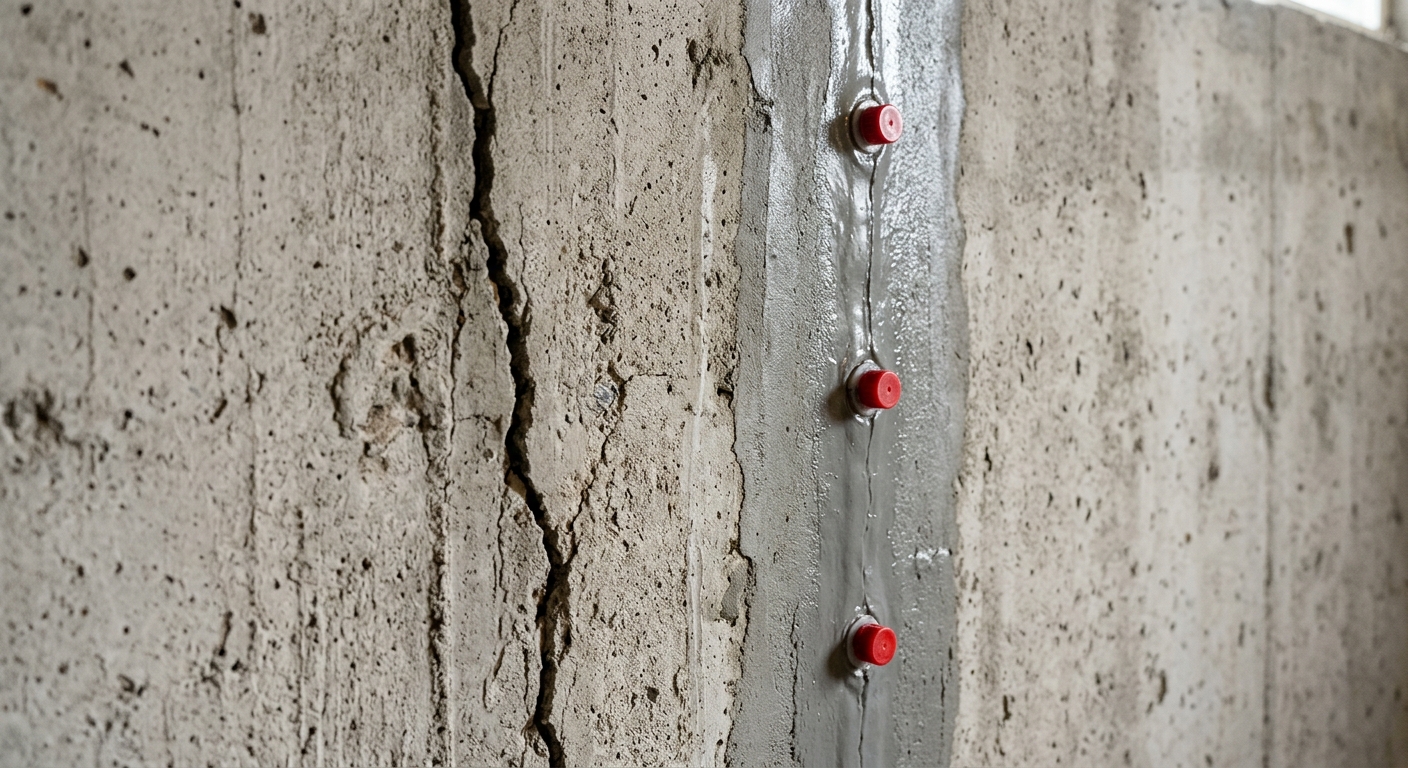
Structural epoxy repair goes beyond waterproofing to restore the tensile and compressive strength that cracked concrete loses when damaged. Foundation walls, basement floors, and load-bearing columns require full structural integrity to safely support building loads and resist soil pressure. Professional-grade epoxy formulations rebuild this strength when applied correctly to qualifying cracks.
Bond Strength Recovery in Cracked Concrete Walls
Properly executed epoxy injection restores 75-90% of a concrete wall's original tensile strength when applied to dormant cracks narrower than 1/8 inch. The epoxy creates a mechanical bond by penetrating the rough crack faces and a chemical bond by adhering to calcium hydroxide in the concrete matrix. This dual bonding mechanism distributes stress across the repair zone rather than concentrating it at the crack tips where propagation typically resumes. Laboratory testing shows that epoxy-repaired concrete often fails in virgin material adjacent to the repair rather than at the bond line — proof that bond strength exceeds the surrounding concrete's capacity.
Structural vs. Cosmetic Cracks — Which Needs Epoxy
Not every foundation crack requires full structural epoxy injection. Cosmetic cracks — narrow surface separations caused by concrete shrinkage during curing — pose no structural threat and can be addressed with surface sealants or flexible polyurethane. Structural cracks result from foundation settlement, soil pressure, or overloading, and appear as horizontal or stair-step patterns wider than 1/8 inch. These cracks compromise wall integrity and demand epoxy injection plus reinforcement to prevent further movement. Signs that distinguish structural from cosmetic damage include:
- Crack width progression — measure and photograph cracks monthly to detect active movement
- Horizontal orientation — indicates lateral soil pressure exceeding wall capacity
- Offset or displacement — one side of the crack sits higher or forward from the other side
- Multiple parallel cracks — pattern suggesting systematic overload rather than isolated shrinkage
- Water infiltration — active leaking proves the crack penetrates the full wall thickness
Professional inspection identifies which cracks threaten structural stability versus which are merely cosmetic concerns. Schedule your free assessment at (314) 798-9554 for expert crack classification.
Carbon Fiber Reinforcement for High-Stress Repairs
High-stress foundation repairs in St. Louis often combine epoxy crack injection with carbon fiber reinforcement straps to prevent re-cracking under ongoing soil pressure. Carbon fiber installation bonds high-tensile-strength fabric strips across repaired cracks using structural epoxy, creating a composite repair stronger than the original concrete. This reinforcement method works particularly well for horizontal cracks caused by expansive clay soil — the carbon fiber resists lateral bowing while epoxy injection seals the crack against water entry. Combined carbon fiber and injection repairs cost $1,200-$2,500 depending on wall length, but eliminate the need for full wall replacement that can exceed $8,000-$12,000.
Epoxy vs. Polyurethane Injection — Which Method for Your Foundation
Choosing between epoxy and polyurethane injection determines whether your foundation repair delivers structural restoration or waterproofing flexibility. Both methods use pressurized injection through drilled ports, but the materials behave completely differently inside the crack void. Understanding which application matches your specific crack type prevents repair failures and wasted investment.
Epoxy for Dormant Cracks vs. Polyurethane for Active Leaks
Use structural epoxy for dormant cracks that show no recent movement and require restored tensile strength — vertical shrinkage cracks, settled corner fractures, or impact damage from excavation. The rigid epoxy bonds crack faces together permanently, rebuilding load-bearing capacity but offering zero tolerance for continued crack movement. Choose polyurethane injection foundation repair for actively leaking cracks where water flows during rain or spring snowmelt. Polyurethane foam expands 20-30 times its liquid volume on contact with water, filling irregular voids and maintaining flexibility as cracks move seasonally with soil expansion and contraction.
Cost Comparison & Longevity of Each Material
Epoxy crack injection costs $30-$50 per linear foot in St. Louis, while polyurethane injection typically runs $25-$40 per foot — slightly less expensive due to material costs and faster installation. However, longevity differs significantly: epoxy repairs last 20+ years in dormant cracks and carry longer warranty periods (10 years vs. 5 years for polyurethane). Polyurethane's flexibility makes it ideal for ongoing movement but susceptible to degradation if cracks continue widening beyond the foam's elastic limit. For static structural cracks, epoxy delivers better long-term value despite higher upfront cost. For dynamic cracks showing seasonal opening and closing, polyurethane's lower initial investment and movement tolerance justify the shorter lifespan.
Flexibility & Movement Tolerance — Epoxy vs. Polyurethane
Flexibility and movement tolerance represent the critical performance difference between these injection materials. Epoxy cures into a rigid thermoset polymer with near-zero elongation — it bonds crack faces into a single structural unit that cannot accommodate ongoing movement without re-cracking. Polyurethane remains permanently elastic with 300-500% elongation capacity, stretching and compressing as foundation walls shift through freeze-thaw cycles. In St. Louis's expansive clay soil environment, this flexibility prevents re-cracking when seasonal moisture changes cause minor wall movement. However, polyurethane's softness means it contributes nothing to structural strength — choose it for waterproofing only, not load-bearing
Frequently Asked Questions
How much does epoxy crack injection cost in St. Louis?
Epoxy crack injection in St. Louis typically costs between $350 and $800 per crack, depending on the length, depth, and location of the damage. Horizontal or hard-to-reach cracks may cost more due to additional labor and materials. Most foundation repair companies in St. Louis offer free inspections and detailed quotes before starting work. Structural repairs using high-grade epoxy are more expensive than simple cosmetic sealing, so pricing varies based on whether the crack threatens your home's stability or is primarily a water entry point.
What is the difference between epoxy and polyurethane injection for foundation cracks?
Epoxy injection is used for structural repairs where cracks need to be permanently bonded and restored to full strength. It hardens into a rigid seal that restores the concrete's load-bearing capacity. Polyurethane injection is designed primarily for waterproofing, as it expands to fill voids and remains flexible to accommodate minor movement. In St. Louis, epoxy is preferred for foundation walls with structural damage, while polyurethane works better for basement walls that leak but remain structurally sound. Your foundation repair specialist will recommend the best material after inspecting the crack type and cause.
How does the epoxy crack injection process work?
The process begins with cleaning the crack and drilling small entry ports along its length. Technicians inject low-viscosity epoxy resin under controlled pressure, starting from the lowest point and moving upward until the crack is completely filled. The epoxy penetrates deep into the concrete and bonds both sides together as it cures. Surface ports are removed after 24 to 48 hours once the epoxy fully hardens. The repair restores structural integrity and prevents water infiltration. Most jobs in St. Louis take two to four hours depending on crack severity and accessibility.
Are foundation repair companies in St. Louis licensed and insured?
Reputable foundation repair companies in St. Louis carry both general liability insurance and workers' compensation coverage to protect homeowners during repairs. Missouri does not require a specific foundation repair license, but experienced contractors often hold certifications from industry organizations like the Foundation Repair Association. Always verify insurance coverage and ask for references or reviews before hiring. A professional company will provide proof of insurance and a written warranty covering both materials and workmanship. Avoid unlicensed contractors who offer unusually low prices, as improper epoxy injection can worsen foundation problems.
How long does epoxy crack injection last?
Properly applied epoxy crack injection creates a permanent repair that typically lasts the lifetime of the structure when the underlying cause of cracking is addressed. Epoxy bonds are often stronger than the surrounding concrete itself. However, if soil settlement, hydrostatic pressure, or drainage issues persist, new cracks may form elsewhere in the foundation. Most St. Louis foundation repair companies offer warranties ranging from five years to lifetime coverage on epoxy injection work. Regular maintenance like proper grading and gutter systems helps ensure the repair remains effective and prevents future foundation movement.
Do you serve all areas of St. Louis County and surrounding suburbs?
Most foundation repair specialists in St. Louis serve the entire metro area, including St. Louis County, St. Charles County, Jefferson County, and surrounding communities like Chesterfield, Ballwin, O'Fallon, Florissant, and Clayton. Service areas often extend 30 to 50 miles from the city center. Some companies may charge a trip fee for locations outside their primary zone. When requesting a quote, confirm that the contractor regularly works in your neighborhood and is familiar with local soil conditions, building codes, and common foundation issues specific to the St. Louis region.
Is epoxy injection covered by homeowners insurance?
Homeowners insurance typically does not cover foundation cracks caused by settling, soil movement, or general wear over time, as these are considered maintenance issues. However, if the crack results from a sudden covered event like a plumbing leak, storm damage, or fire, your policy may provide coverage. Review your policy or contact your insurance agent before scheduling repairs. Many St. Louis foundation repair companies can work directly with insurance adjusters and provide detailed documentation if your claim qualifies. Even without coverage, epoxy injection is often more affordable than extensive foundation replacement.
How quickly can you respond to foundation crack emergencies in St. Louis?
Many foundation repair companies in St. Louis offer emergency services and can respond within 24 to 48 hours for urgent situations like active water infiltration or rapidly widening cracks. Non-emergency appointments are usually scheduled within three to seven business days. Spring and fall are peak seasons due to ground movement from freeze-thaw cycles and heavy rain, which may extend scheduling times. Calling early and describing the severity helps prioritize your repair. Temporary measures like hydraulic cement patches can slow water entry until professional epoxy injection is completed.
Book your free foundation inspection
Tell us what you are seeing and where the home is. The inspection is free, there is no obligation, and you get a written estimate showing the repair method, the number of piers or anchors and the total before anything is scheduled.