Load bearing beam replacement is the foundation of structural safety for St. Louis homeowners facing sagging floors, cracked walls, or visible beam deterioration. Your home's structural integrity depends on properly sized, engineered support beams — and when those beams fail, every floor above them is at risk. Our licensed structural team provides steel beam foundation support solutions designed specifically for St. Louis soil conditions, ensuring your home remains safe, stable, and code-compliant. Whether you're dealing with an emergency beam failure or planning a renovation that requires beam modification, we deliver engineered steel solutions with stamped certifications that protect your home value and your family's safety.
What Is Load Bearing Beam Replacement and When Do You Need It?
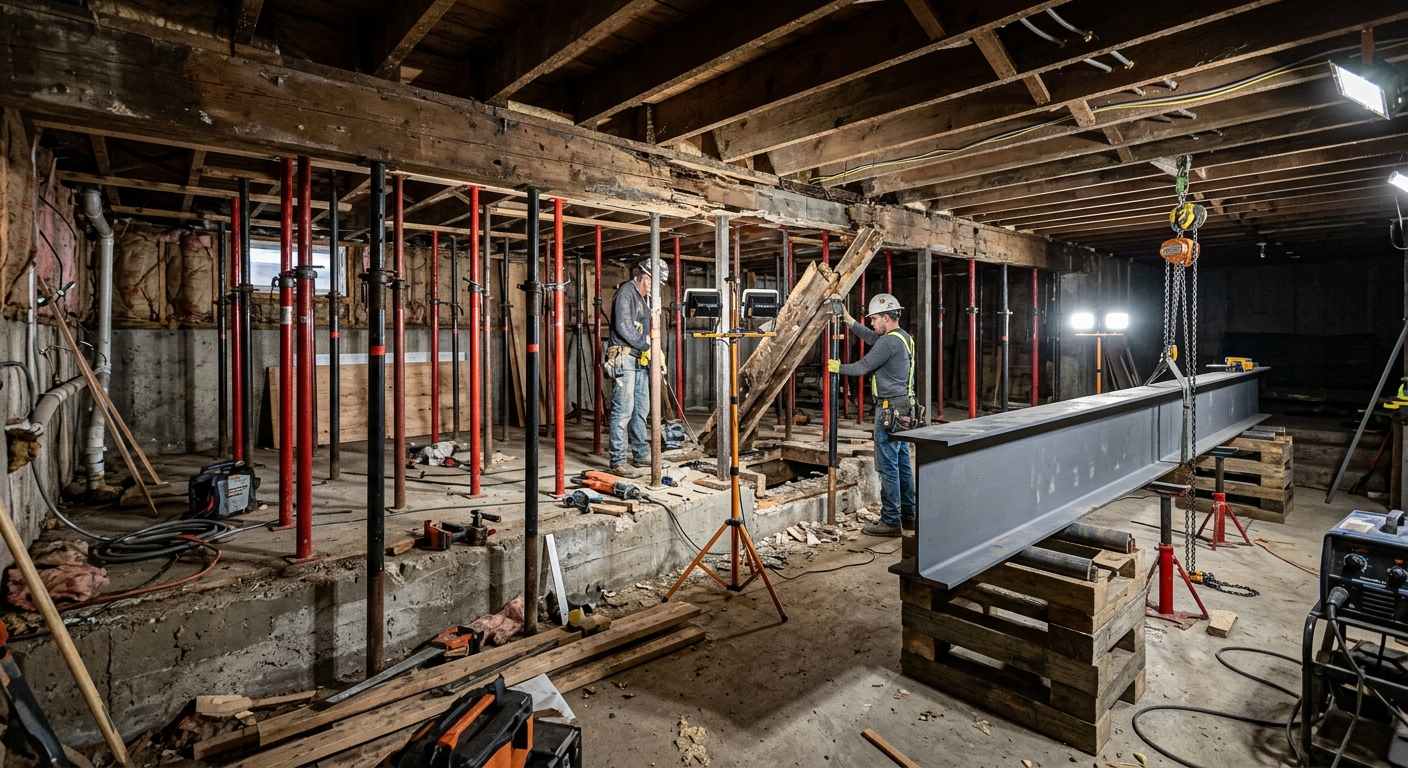
Load bearing beam replacement involves removing a damaged, undersized, or deteriorated support beam and installing a properly engineered steel beam to carry the structural load of your home. This isn't cosmetic work — it's critical foundation infrastructure that prevents progressive structural failure. You need beam replacement when the existing beam can no longer safely support the weight of floors, walls, and roof above it. St. Louis homes built before 1980 often used undersized wood beams that were adequate at construction but fail under decades of soil movement, moisture exposure, and increasing load demands from renovations.
Signs Your Beam Needs Replacement: Sagging Floors, Cracks & Rot
Your home communicates structural problems through visible symptoms. Sagging floors that slope toward the center of your home indicate a failing support beam beneath. Cracks in drywall running diagonally from door frames or appearing above windows signal beam deflection causing the frame to shift. Doors that suddenly won't close properly or stick in their frames reflect foundation movement tied to beam failure. In basements, inspect your existing beam directly — visible rot, rust-through on steel, or wood that crumbles when prodded are emergency conditions requiring immediate replacement. Bouncy floors when walking across rooms, especially near the center span, indicate the beam has lost its load capacity and is deflecting under weight it should easily support.
- Floor sag exceeding 1 inch measured from level — this represents structural deflection beyond cosmetic concern
- Cracks in foundation walls near beam support points, showing the beam is shifting or overloading the foundation
- Visible beam deterioration — rust, rot, splits, or warping that compromises cross-sectional strength
- Water staining or mold on wood beams in basements, indicating moisture penetration and loss of structural integrity
- New cracks appearing after heavy rain or seasonal temperature changes, tied to soil movement stressing the beam
If you're seeing any of these warning signs, call (314) 798-9554 for a same-day structural assessment. Beam failure accelerates once it begins — early intervention costs less and prevents cascading damage.
Why St. Louis Homes Experience Faster Beam Failure (Expansive Clay Soil)
St. Louis sits on expansive clay soil that swells when saturated and shrinks during dry periods, creating seasonal foundation movement that places extraordinary stress on load bearing beams. This isn't speculation — it's documented geology. The Maquoketa shale and clay formations underlying most of St. Louis County expand up to 10% in volume when wet, then contract during summer heat or winter freezes. Your foundation shifts with this cycle, and your support beams absorb the stress. Wood beams in St. Louis basements face a second threat: constant moisture exposure from clay soil retaining water against foundation walls. Even treated lumber rots when exposed to 60%+ humidity for years, and untreated beams fail in under a decade.
Steel beams resist moisture damage, but undersized steel beams installed in the 1960s-1980s still fail under the repetitive stress of soil movement. The combination of expansive clay and freeze-thaw cycles makes St. Louis one of the most demanding environments for foundation support systems in the Midwest. This is why steel beam foundation support St. Louis contractors see higher replacement rates than other regions — the geology doesn't forgive undersized or deteriorating beams.
Code-Required Steel Beam Upgrades During Renovation
Missouri residential building code requires engineered steel beams with stamped load calculations for any span exceeding 8 feet or supporting loads from more than one floor level. If you're removing a load bearing wall during a kitchen or basement remodel, you cannot simply sister a wood beam and call it done — the city inspector will fail your permit. Any renovation that modifies structural support triggers code compliance review, and modern standards mandate steel for permanent, verifiable load capacity. This protects you: properly engineered beams prevent catastrophic failure, and stamped certifications protect your home's resale value by proving structural modifications were done to code.
Even if your project doesn't require a permit, using engineered steel beams is the responsible choice. Wood beam sizing relies on span tables that don't account for St. Louis soil conditions or long-term moisture exposure. Steel beams provide predictable, verifiable strength that doesn't degrade over time, and they meet or exceed code requirements that protect your family and your investment.
Steel Beam Foundation Support in St. Louis: Why Steel Is the Right Choice
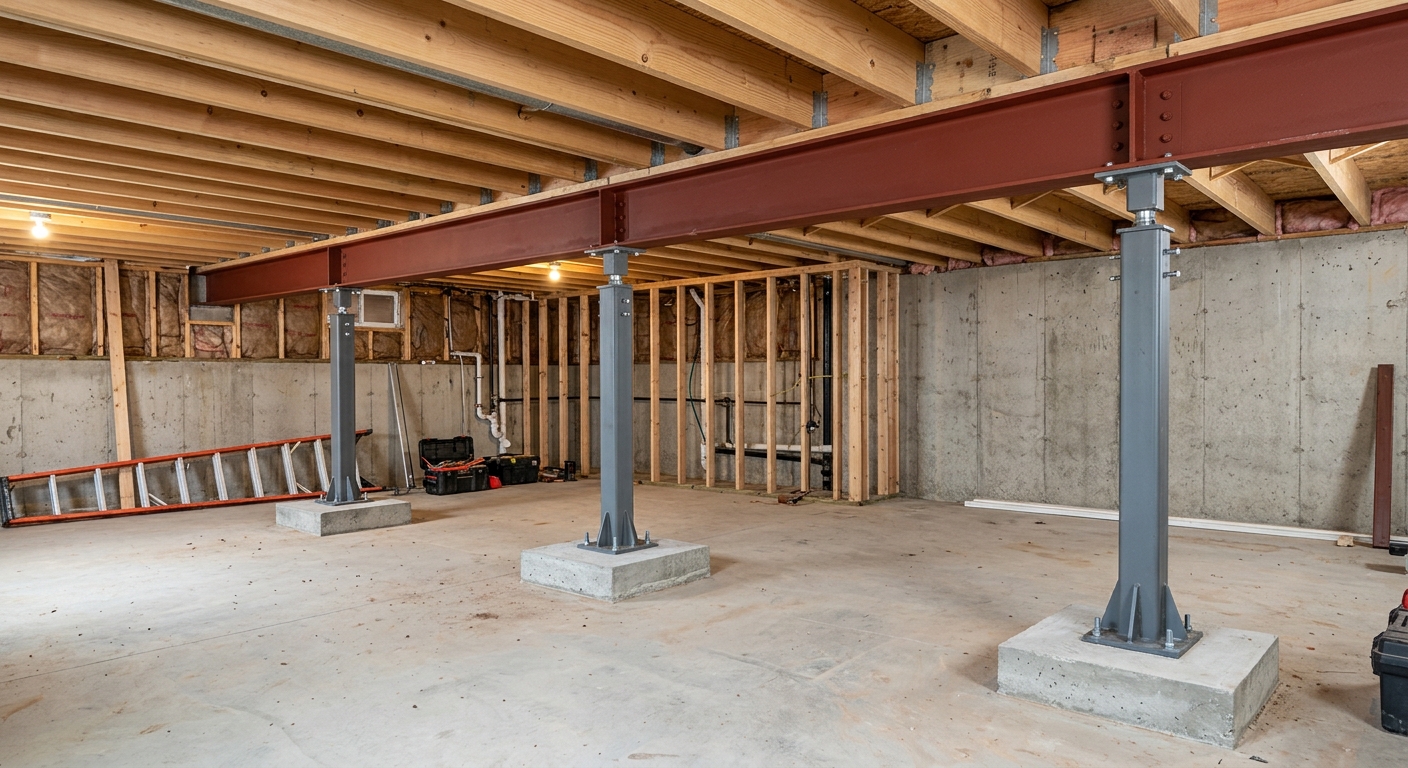
Steel beam foundation support St. Louis homeowners rely on delivers three critical advantages: superior load capacity, resistance to moisture damage, and compliance with modern structural codes. A steel I-beam's strength comes from its engineered shape and material properties — steel doesn't warp, rot, or compress under load the way wood does. For St. Louis homes dealing with expansive clay soil and high basement humidity, steel eliminates the primary failure modes that destroy wood beams. When you replace a failing beam with properly sized steel, you're installing a permanent solution designed to outlast the home itself. Our team uses only structural-grade steel beams fabricated to exact specifications with load calculations stamped by a Missouri-licensed structural engineer.
How Expansive Clay Soil Damages Wood Beams Faster
Expansive clay soil creates a moisture trap against your foundation walls, maintaining humidity levels in unfinished basements between 60-80% year-round. Wood absorbs this moisture, swelling and then shrinking as humidity fluctuates with seasons. This cycle weakens wood fiber, creating microfractures that accelerate rot and invite fungal growth. Within 10-15 years, even pressure-treated wood beams in St. Louis basements show significant deterioration — soft spots, surface rot, and loss of load-bearing cross-section. The support beam carries your entire home's weight, so even 20% deterioration represents a safety hazard.
Steel doesn't absorb moisture. While surface rust can develop on uncoated steel, it doesn't penetrate or compromise structural integrity the way rot destroys wood. Modern steel beams used in foundation support applications come mill-coated or galvanized to resist corrosion, providing decades of reliable service even in high-humidity basements. This is why building codes increasingly mandate steel for below-grade structural applications — the material matches the environment.
Steel vs. Wood: Load Capacity and Durability Comparison
A 6-inch steel I-beam spanning 12 feet can support approximately 10,000 pounds of distributed load — roughly equivalent to a 4×12 wood beam of the same length. But the steel beam weighs 60 pounds versus 120+ pounds for the wood, making installation easier and placing less dead load on the foundation. More importantly, the steel beam's capacity doesn't degrade over time. That same wood beam loses 10-15% of its strength per decade from moisture exposure, compression, and fiber breakdown, while the steel beam maintains full capacity for 50+ years.
For longer spans common in open-concept St. Louis homes (15-20 feet), steel becomes the only practical option. An 8-inch I-beam spanning 18 feet supports 15,000+ pounds — a wood beam of equivalent capacity would require a massive 6×14 or larger section that's cost-prohibitive and difficult to install in existing structures. Steel allows you to remove walls and create open spaces without sacrificing structural integrity or requiring intrusive support columns every 8 feet.
- Steel maintains 100% load capacity for 50+ years, while wood degrades 10-15% per decade in humid basements
- Steel I-beams provide 40-60% more strength per pound than equivalent wood sections, reducing dead load on foundations
- Longer clear spans — steel allows 18-24 foot spans without mid-span support, impossible with code-compliant wood beams
- Fire resistance — steel beams resist fire longer than wood, maintaining structural integrity during emergencies
Missouri Building Code Requirements for Load Bearing Beams
Missouri follows the International Residential Code (IRC) with state amendments that govern load bearing beam specifications. Any beam supporting more than one floor level or spanning more than 8 feet requires engineered design with stamped calculations from a licensed structural engineer. You cannot use span tables from a hardware store for these applications — the beam size, material grade, and connection details must be specified by an engineer who accounts for your home's specific loads, soil conditions, and support point locations.
Inspectors verify beam size matches engineer specifications, check that support columns bear on proper footings (not just concrete slabs), and confirm connection hardware meets code. Steel beams must use bolted or welded connections — nails and screws don't provide adequate shear strength for steel-to-steel joints. These requirements exist because structural failures kill people and destroy homes. Proper engineering and code compliance protect you legally, financially, and physically.
For permit-required renovations, you'll need to submit engineer-stamped plans before starting work. Our team handles this process end-to-end, providing the structural assessment, engineer coordination, beam fabrication, installation, and final inspection — so you get code-compliant work without navigating the bureaucracy yourself. Call (314) 798-9554 to discuss your project requirements and timeline.
Foundation Steel Beams Cost: Pricing Breakdown for St. Louis Homeowners
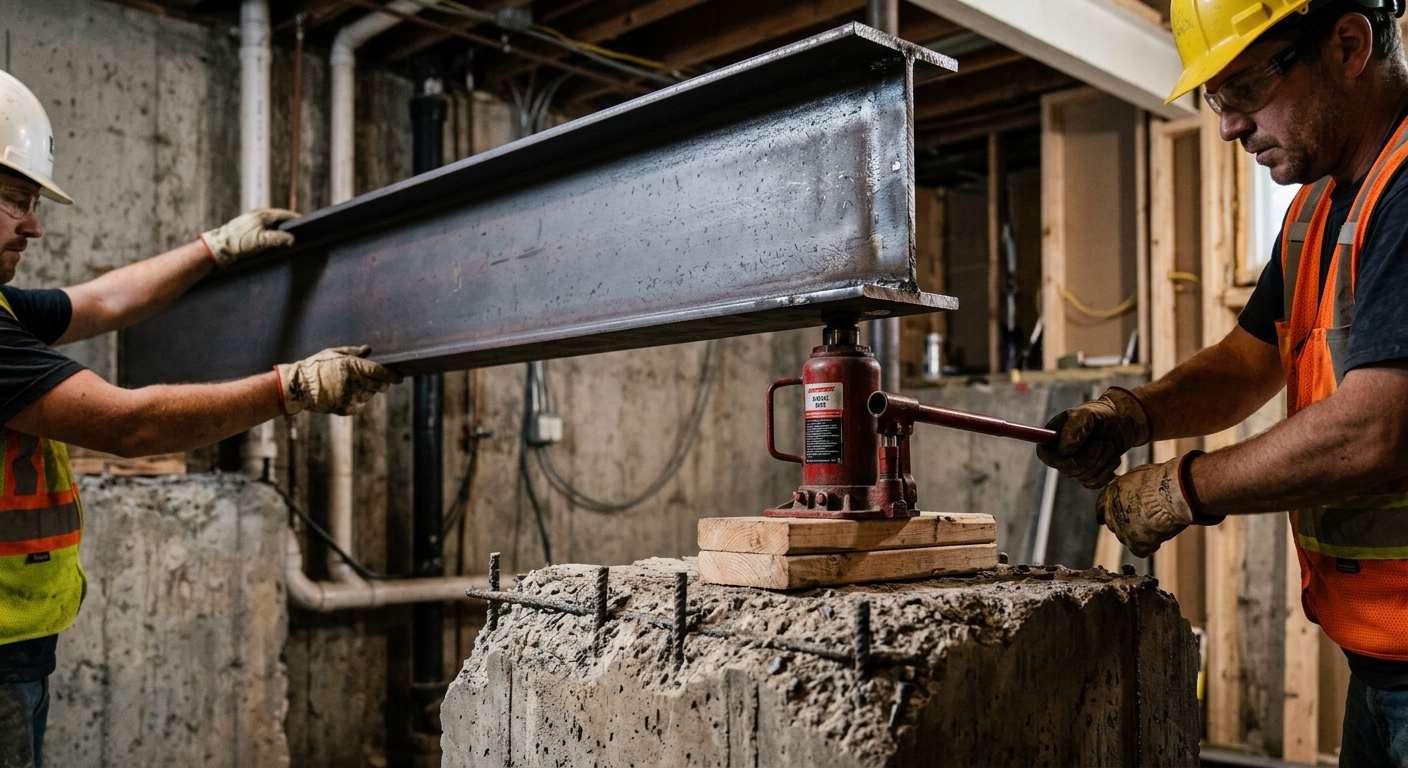
Foundation steel beams cost varies based on beam size, span length, access difficulty, and whether foundation repairs are required before installation. Most residential steel beam replacements in St. Louis range from $3,500 to $9,000, with the majority of projects landing between $4,500 and $6,500. This includes the engineered steel beam, fabrication, delivery, temporary support installation, professional installation, engineer inspection, and final finish work. Basement steel beam support projects on the lower end typically involve shorter spans (10-12 feet) in accessible crawl spaces or unfinished basements. Higher-cost projects involve longer spans (18+ feet), finished spaces requiring drywall removal and replacement, or situations where foundation settlement must be corrected before the new beam can be installed.
Typical Steel Beam Replacement Cost Range ($3,500–$9,000)
A standard 12-foot steel I-beam replacement in an unfinished St. Louis basement with good access typically costs $4,200-$5,500. This includes a 6-inch or 8-inch I-beam depending on load calculations, two lally columns or adjustable support posts, temporary support during installation, and final cleanup. If your basement is finished and we need to remove drywall or drop ceiling sections to access the beam, add $800-$1,500 for demo and finish work. Longer spans requiring heavier beams push costs higher — an 18-foot 10-inch I-beam replacement in a finished basement can reach $8,000-$9,000 due to material cost, rigging requirements, and finish work.
Emergency beam support for actively failing beams may include expedited scheduling and temporary shoring, adding $500-$1,000 to standard pricing but preventing catastrophic structural collapse. Foundation settlement issues that must be addressed before beam installation (helical piers, mudjacking, or underpinning) add $2,500-$8,000 depending on severity — but these are separate foundation repairs, not part of the beam replacement itself. We provide transparent, itemized quotes so you understand exactly what you're paying for and why.
What Affects Your Final Price: Beam Size, Access, and Permits
Beam size directly determines material cost. A 6-inch I-beam costs approximately $8-$12 per linear foot, an 8-inch beam $14-$20, and a 10-inch beam $25-$35. The engineer calculates required size based on span length and load — you can't choose a smaller beam to save money without compromising structural integrity and code compliance. Access affects labor cost significantly. Basements with exterior access doors allow us to bring beams and equipment in easily. Homes where we must navigate beams through narrow stairways, around tight corners, or through bulkhead openings require more time and crew members, increasing labor 20-40%.
Permit fees in St. Louis County run $150-$350 depending on project scope, and the required engineer report adds $400-$800 to your total project cost. These aren't optional expenses — they're legal requirements for permitted structural work. Some contractors skip permits to offer lower prices, but you'll face fines, failed inspections, and title issues when selling your home. We pull all required permits and coordinate engineer inspections, so your project is done right and documented properly.
- Beam span length — 10-foot span might use a 6-inch beam ($350), while 20-foot span requires 10-inch beam ($1,200+)
- Basement access — exterior door access costs 30% less labor than navigating beams down interior stairs
- Support column requirements — each additional support post adds $300-$500 including footing and column installation
- Finish work — unfinished basements require minimal patching; finished spaces add drywall, paint, ceiling repair costs
- Foundation condition — cracked or settling foundations require stabilization before beam installation, separate from beam cost
Why Engineered Steel Beams Cost More (and Save Money Long-Term)
Engineered steel beams cost 40-60% more than DIY wood beam sistering, but they deliver permanent solutions that wood can't match in St. Louis soil conditions. A properly sized steel beam installed with engineer certification lasts 50+ years without maintenance, doesn't require replacement when moisture damages wood, and meets code requirements that protect your home's resale value. When you sell your home, buyers' inspectors scrutinize structural modifications. A wood beam sistered onto a failing beam without permits raises red flags, triggers renegotiation, and can kill deals. A permitted, engineered steel beam replacement with stamped certifications proves the work was done correctly and adds value.
Consider the total cost of ownership: a $2,500 wood beam repair fails in 8-12 years, requiring another $3,000+ replacement — plus you've paid for any additional damage the failing beam caused to floors, walls, and finishes during those years. A $5,500 engineered steel beam installed once lasts the life of your home, prevents progressive damage, and satisfies code requirements. The higher upfront cost eliminates future expenses and protects your largest financial asset. That's not cost — it's investment.
Steel Support Beam Installation: The Complete Process
Steel support beam installation follows a precise sequence designed to maintain structural safety throughout the project while delivering code-compliant, engineered results. Our process begins with a comprehensive structural assessment and ends with final engineer inspection and certification — every step documented and executed to Missouri building code standards. Most residential beam replacements in St. Louis take 1-3 days depending on span length, access conditions, and whether finish work is required. We protect your home with dust barriers, temporary support systems that prevent sagging during beam removal, and careful rigging that prevents damage to floors, walls, and ceilings during installation.
Step 1: Structural Assessment and Load Calculations
Every steel support beam installation begins with a detailed structural assessment performed by our licensed team. We measure the existing beam span, identify support point locations, assess foundation condition, and document floor level measurements to quantify sag. We inspect for signs of foundation settlement, check support columns for plumb and stability, and photograph existing damage for documentation. This information goes to our structural engineer who calculates required beam size based on dead loads (structure weight), live loads (occupancy and furnishings), and span length.
The engineer produces stamped calculations and a specification sheet detailing beam size, material grade, support column spacing, connection hardware, and footing requirements. This engineering report is submitted with your building permit application and becomes the blueprint for installation. Nothing is guessed
Frequently Asked Questions
How much does load bearing beam replacement cost in St. Louis?
Load bearing beam replacement in St. Louis typically ranges from $2,500 to $8,000 depending on beam length, material type, and accessibility. Steel beams generally cost more than engineered wood but offer superior longevity and load capacity. Foundation repair st louis mo provides free in-home estimates that account for your specific structural requirements, basement layout, and local building code compliance. Final pricing includes beam materials, temporary support installation, structural engineering if needed, and professional labor.
How does the load bearing beam replacement process work?
The replacement process begins with a thorough structural assessment to determine load requirements and beam specifications. Our technicians install temporary support posts to safely transfer the weight from the failing beam. We then remove the damaged beam, prepare the support columns or foundation walls, and install the new steel or engineered lumber beam. After proper positioning and securing, we remove temporary supports and verify structural integrity. Most residential beam replacements in St. Louis homes are completed within one to two days depending on complexity and accessibility.
What are the signs I need load bearing beam replacement?
Common warning signs include sagging or uneven floors above the basement, visible cracks in walls or ceilings, doors and windows that stick or won't close properly, and visible damage to existing support beams like rot, rust, or bowing. You may also notice separation between walls and ceiling, or hear creaking sounds when walking across floors. If your St. Louis home was built before 1980 or has experienced foundation settlement or water damage, the original support beams may have deteriorated and require professional inspection and possible replacement.
Are you licensed and insured for structural beam work in Missouri?
Yes, foundation repair st louis mo maintains full licensing, bonding, and comprehensive liability insurance for all structural repair work throughout Missouri. Our technicians hold proper certifications for foundation and structural beam installation, and we comply with all St. Louis County and City building codes. We pull necessary permits for beam replacement projects and arrange required inspections to ensure your work meets structural engineering standards. Our insurance coverage protects your property throughout the entire installation process, giving you complete peace of mind during this critical home repair.
What is the difference between steel beams and engineered wood beams for foundation support?
Steel beams offer superior strength-to-size ratio, resist moisture and pest damage, and can span longer distances without additional support posts. They typically last 50-plus years and handle heavier loads in St. Louis basements. Engineered wood beams like LVL or glulam cost 30-40% less, install more easily, and work well for standard residential loads. However, they're susceptible to moisture damage in humid basement environments and may require more frequent inspection. For foundation support applications, steel beams generally provide better long-term value despite higher upfront costs.
Do you serve the entire St. Louis metro area for beam replacement?
Yes, we provide load bearing beam replacement throughout the greater St. Louis region including St. Louis County, St. Charles County, Jefferson County, and surrounding Missouri communities. Our service area covers Clayton, Kirkwood, Chesterfield, O'Fallon, Florissant, Webster Groves, and all nearby suburbs. We respond to both emergency structural situations and scheduled replacement projects. Travel fees rarely apply within our primary service zone. Contact foundation repair st louis mo for confirmation that we serve your specific neighborhood and to schedule your free structural assessment.
How long does a replaced load bearing beam last?
Properly installed steel support beams typically last 75-100 years in controlled basement environments, while engineered lumber beams last 40-60 years when protected from moisture. Lifespan depends on material quality, correct load calculations, proper installation, and ongoing basement moisture control. Foundation repair st louis mo uses commercial-grade materials that meet or exceed structural engineering specifications for residential applications. We provide written warranties on both materials and installation workmanship. Regular basement inspections every 5-10 years help identify minor issues before they compromise your beam's structural integrity or require premature replacement.
Can you perform emergency load bearing beam replacement in St. Louis?
Yes, we offer emergency structural support services for failing load bearing beams throughout St. Louis. When beams show signs of imminent failure—severe sagging, cracking sounds, sudden floor drops, or visible beam fractures—immediate temporary support installation prevents catastrophic structural damage. We respond to emergency calls within 2-4 hours during business hours and provide next-day service for after-hours situations. Our crews carry temporary support equipment and can stabilize dangerous situations immediately, then schedule permanent beam replacement within 3-5 business days depending on material availability and permit requirements.
Book your free foundation inspection
Tell us what you are seeing and where the home is. The inspection is free, there is no obligation, and you get a written estimate showing the repair method, the number of piers or anchors and the total before anything is scheduled.