Foundation underpinning cost in St. Louis depends on your home's specific soil conditions, the extent of settlement, and the depth required to reach stable ground. Most St. Louis homeowners pay between $5,000 and $18,000 for professional underpinning services, though complex projects involving deep excavation or extensive cracking can exceed $25,000. The good news? Addressing foundation settlement now prevents far costlier structural damage down the road — and protects your home's value in a competitive real estate market.
St. Louis sits on expansive clay soil that swells when wet and shrinks during dry periods, creating the relentless pressure that causes foundation walls to crack, floors to slope, and doorframes to stick. If you've noticed widening cracks above windows, gaps between walls and ceilings, or basement moisture issues, you're likely facing settlement that requires professional foundation repair. Our team specializes in engineered underpinning solutions for St. Louis homes, and we'll help you understand your options, costs, and timeline before you commit to anything. Call (314) 798-9554 for a free inspection and transparent pricing — no pressure, just honest answers.
What Does Foundation Underpinning Cost in St. Louis?
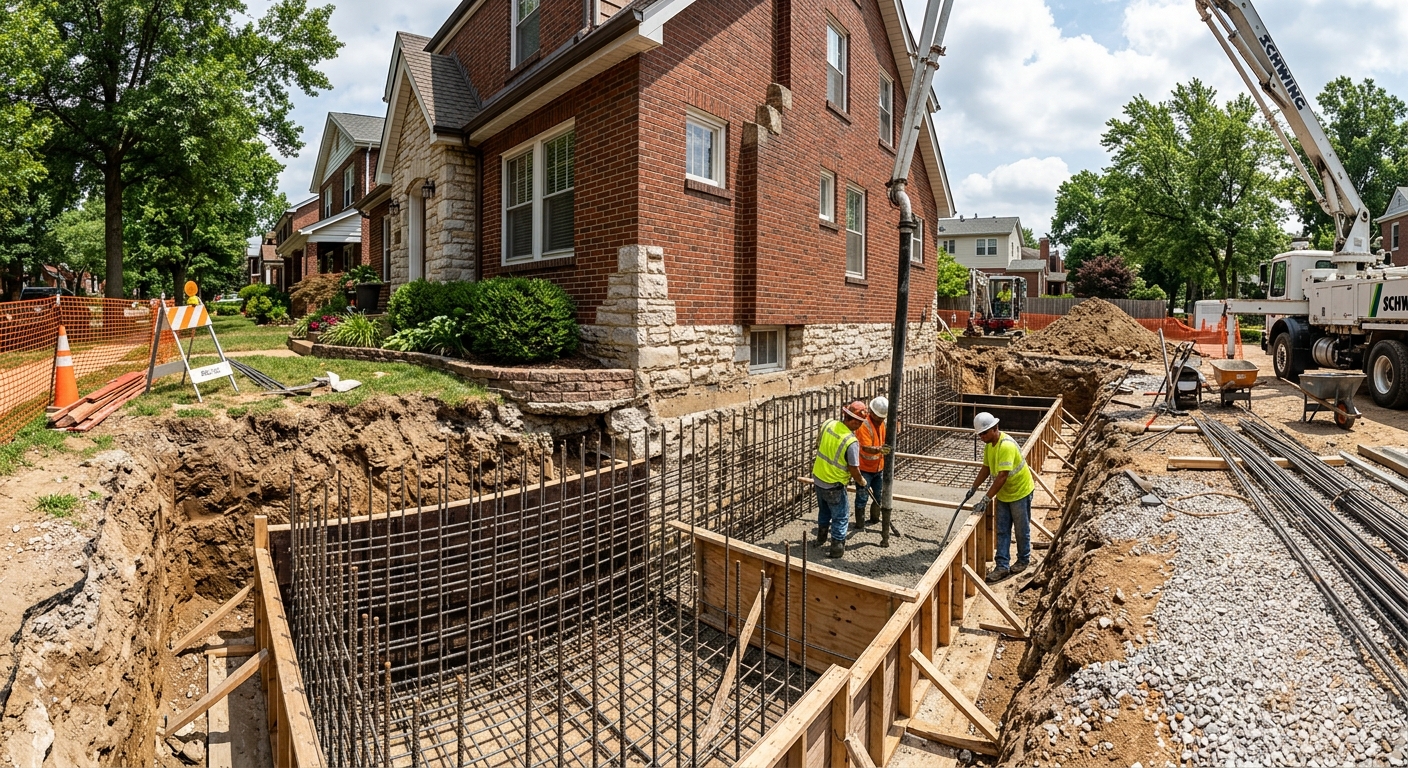
Foundation underpinning St. Louis projects typically range from $250 to $450 per linear foot, with the final price determined by excavation depth, soil conditions, and the method your foundation requires. Most residential underpinning jobs involve 20 to 40 linear feet of repair, putting total project costs between $5,000 and $18,000 for homes with moderate settlement. Larger homes with perimeter foundation issues or severe structural damage can require 60+ linear feet of underpinning, pushing costs into the $20,000–$30,000 range.
Typical Cost Range for St. Louis Underpinning Projects
Here's what St. Louis homeowners actually pay for professional underpinning, broken down by project scope:
- Minor settlement repair (10–20 linear feet): $2,500–$9,000 — common for isolated corner settlement or single wall sections
- Moderate foundation stabilization (20–40 linear feet): $5,000–$18,000 — typical for homes with multiple cracks or noticeable floor slopes
- Extensive perimeter underpinning (40–80 linear feet): $18,000–$36,000 — necessary when settlement affects multiple walls or structural integrity is compromised
- Whole-home reinforcement (80+ linear feet): $30,000–$60,000+ — rare but required for severe soil failure or homes built on inadequate footings
These figures include excavation, materials, labor, engineering reports, and permits. Your final cost depends heavily on how deep contractors must dig to reach stable soil — a critical factor in St. Louis clay.
Factors That Affect Foundation Underpinning Costs
Not all underpinning projects cost the same, even for similar-sized homes. These variables drive your final price:
- Excavation depth: St. Louis underpinning typically extends 8–12 feet below grade to reach stable soil or bedrock, compared to 4–6 feet in regions without expansive clay. Deeper excavation means more labor and material.
- Access and site conditions: Tight side yards, landscaping obstacles, or finished basements increase labor time and equipment costs.
- Foundation type: Poured concrete foundations cost less to underpin than stone or brick foundations, which require more delicate handling.
- Soil composition: Heavily saturated clay or unstable fill dirt requires deeper footings and potentially additional drainage solutions, adding $1,500–$4,000 to the project.
- Structural engineering requirements: St. Louis County and City require engineering approval for underpinning, adding $800–$1,500 upfront but ensuring code compliance and long-term safety.
When you call (314) 798-9554, we'll schedule a free on-site inspection to measure the exact linear footage your home needs and provide a detailed cost breakdown before any work begins.
Cost Breakdown: Labor, Materials & Engineering
Understanding where your money goes helps you evaluate quotes and avoid surprise charges. A typical St. Louis underpinning project breaks down like this:
- Excavation & shoring (30–40% of cost): Hand-digging beneath your existing foundation, installing temporary supports, and removing soil safely.
- Concrete & rebar materials (25–30%): High-strength concrete poured in sections, reinforced with steel rebar to support your home's weight permanently.
- Labor & skilled trades (25–30%): Licensed foundation specialists who understand St. Louis soil conditions and building codes.
- Engineering & permits (5–10%): Structural engineer's report, city/county permits, and inspections to ensure code compliance.
- Restoration & finishing (5–10%): Backfilling excavated areas, compacting soil, and repairing landscaping or interior basement walls disturbed during work.
Reputable contractors provide itemized quotes — if a bid lumps everything into one vague number, that's a red flag. Transparent pricing protects you from hidden fees and ensures you're comparing apples to apples across multiple quotes.
How Much Does Foundation Stabilization Cost?
Stabilize foundation cost in St. Louis varies widely because "stabilization" is an umbrella term covering multiple repair methods — underpinning, helical piers, push piers, carbon fiber straps, and epoxy crack injection. Simple stabilization like crack sealing costs $500–$2,000, while full structural stabilization using piers or underpinning ranges from $4,000 to $30,000+ depending on severity. The key question: does your foundation need surface-level repair, or does it require deep structural intervention to stop ongoing settlement?
Foundation Stabilization vs Underpinning: Cost Comparison
Many homeowners confuse stabilization with underpinning. Here's how they differ — and what each costs:
- Crack sealing & epoxy injection ($500–$2,500): Cosmetic repair that stops water intrusion but doesn't address settlement. Works only if your foundation isn't actively moving.
- Carbon fiber wall reinforcement ($1,500–$5,000): Stabilizes bowing basement walls without excavation. Suitable for walls with less than 2 inches of horizontal movement.
- Helical piers ($1,200–$1,800 per pier, 4–8 piers typical): Screwed into soil to stabilize and lift settled foundations. Total cost: $5,000–$14,000 for most homes. Best for lighter structures or new construction.
- Push piers ($1,300–$2,000 per pier, 6–12 piers typical): Hydraulically driven to bedrock for maximum load capacity. Total cost: $8,000–$24,000. Ideal for heavier homes or severe settlement.
- Mass concrete underpinning ($250–$450 per linear foot): Excavating beneath your foundation and pouring reinforced concrete to extend footing depth. Total cost: $5,000–$30,000+. The gold standard for deep foundation repair in St. Louis clay.
Underpinning costs more upfront but provides the most permanent solution for homes with significant settlement or soil failure. Piers cost less per installation point but may require more units to achieve the same load distribution. We help you choose the right method for your soil, structure, and budget — call (314) 798-9554 to discuss your specific situation.
When Stabilization Costs Less Than Full Underpinning
You don't always need underpinning. Here's when less invasive (and less expensive) stabilization methods work:
- Hairline cracks under 1/8 inch wide with no active movement → epoxy injection ($500–$1,200)
- Bowing basement walls with less than 2 inches of deflection → carbon fiber straps ($1,500–$4,000)
- Isolated corner settlement affecting 10 linear feet or less → 2–4 helical piers ($2,500–$7,000)
- Slab settlement causing uneven floors but no structural cracking → slab jacking or foam injection ($1,200–$3,500)
These methods stabilize your foundation and prevent further movement, but they don't extend footing depth the way underpinning does. If your soil is actively failing or settlement exceeds 1 inch, underpinning is usually the only solution that prevents future problems. A professional inspection reveals which approach your home needs — we provide honest assessments, not scare tactics.
Long-Term Value of Foundation Repair Investment
Foundation underpinning costs thousands, but delaying repair costs even more. Here's the financial reality St. Louis homeowners face:
- Home value protection: Homes with documented foundation issues sell for 10–20% less than comparable properties, and many buyers walk away entirely when inspections reveal settlement.
- Cost escalation: Settlement that goes unaddressed for 2–3 years typically doubles in severity, increasing repair costs by 40–60%. A $7,000 underpinning job today becomes a $12,000–$16,000 project tomorrow.
- Secondary damage prevention: Foundation movement causes cracked drywall, stuck doors/windows, plumbing leaks, and roof damage — repairs that add $3,000–$8,000 to your total bill if settlement continues.
- Insurance and selling complications: Unrepaired foundation damage can void homeowner's insurance and kill real estate deals. Engineered repairs with transferable warranties add value and peace of mind.
Our underpinning work comes with a lifetime warranty on materials and workmanship, protecting your investment and making your home easier to sell when the time comes. Get your free estimate by calling (314) 798-9554 today.
Deep Foundation Repair Methods: Underpinning vs Helical Piers vs Push Piers
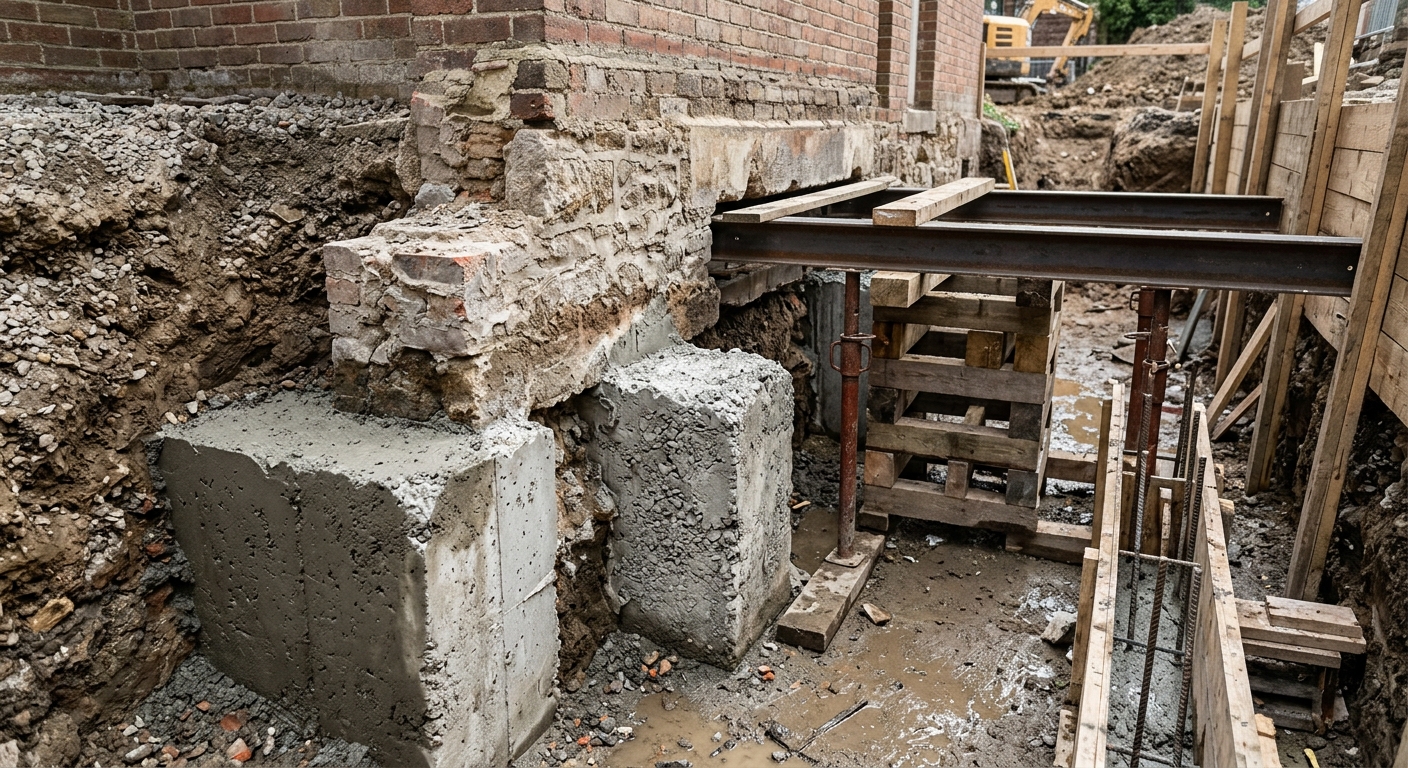
Deep foundation repair in St. Louis requires reaching stable soil or bedrock below the active clay zone — typically 8 to 12 feet below grade. Three methods dominate the market: traditional mass concrete underpinning, helical piers (screw piles), and push piers (resistance piers). Each has specific applications, cost structures, and performance characteristics in St. Louis soil conditions. Choosing the wrong method wastes money or fails to solve your settlement problem permanently.
Underpinning for Deep Foundation Repair
Mass concrete underpinning involves excavating beneath your existing foundation in sections, pouring reinforced concrete footings to extend foundation depth, and allowing each section to cure before moving to the next. This method provides the largest load-bearing surface area and works for any foundation type — poured concrete, block, brick, or stone. It's the oldest, most proven technique and remains the gold standard for severe settlement in St. Louis.
- Best for: Homes with perimeter settlement, heavy masonry construction, or foundations requiring uniform load distribution across long wall sections
- Depth capability: Extends footings 8–16 feet below grade, reaching stable soil or bedrock regardless of clay depth
- Load capacity: Supports unlimited weight — ideal for multi-story homes or additions that increased foundation load
- Lifespan: Permanent solution; properly poured concrete underpinning lasts the life of the home (80+ years)
- Timeline: 1–3 weeks depending on linear footage; requires sequential excavation and curing time
Underpinning costs more than pier systems upfront but provides unmatched stability and versatility. If your home has severe cracking, multiple areas of settlement, or foundation walls that need complete reinforcement, underpinning is usually the only solution that addresses the root cause.
Helical Piers vs Underpinning in St. Louis Clay Soil
Helical piers (also called screw piles or helical anchors) are steel shafts with welded helical plates that screw into the soil like giant screws. They're installed hydraulically from outside your foundation and attached to your footing with brackets. Helical piers work well in lighter structures and new construction but have limitations in St. Louis clay soil that homeowners need to understand.
- Installation speed: Faster than underpinning — most homes need 4–8 piers installed in 1–2 days
- Cost per unit: $1,200–$1,800 per pier, but you may need 8–12 piers to match underpinning's load distribution
- Soil suitability: Perform best in stable, moderately dense soil. St. Louis clay can experience lateral movement that reduces long-term pier effectiveness.
- Lifting capability: Limited lift potential (1–2 inches max) compared to underpinning, which can fully restore foundation elevation
- Best for: Lighter homes, crawl space foundations, or localized settlement affecting small areas
Helical piers cost less per installation point but may require more units to achieve adequate support, sometimes matching or exceeding underpinning costs. In expansive clay soil, underpinning's continuous footing often outperforms point-load pier systems long-term. We assess your soil, structure, and settlement pattern to recommend the most cost-effective solution — call (314) 798-9554 for an honest evaluation.
Push Piers and Segmented Underpinning Solutions
Push piers (also called resistance piers) are hydraulically driven steel tubes that transfer your home's weight to deep, stable soil or bedrock. Unlike helical piers, they're pushed straight down using your home's weight as resistance, making them ideal for heavy structures and severe settlement. They're often combined with segmented underpinning — a hybrid approach that uses concrete underpinning in some areas and piers in others to optimize cost and performance.
- Load capacity: Highest of all pier systems — each push pier supports 40,000–70,000 lbs, making them suitable for multi-story homes and commercial foundations
- Depth capability: Can reach bedrock 30+ feet deep if necessary, far beyond underpinning's practical depth limit
- Lifting power: Provides maximum lift potential — can restore foundation to original elevation in many cases
- Cost: $1,300–$2,000 per pier; most homes need 6–12 piers ($8,000–$24,000 total)
- Best for: Heavy brick or stone homes, severe settlement exceeding 2 inches, or foundations where underpinning excavation isn't feasible due to access constraints
Segmented underpinning combines push piers at critical load points with mass concrete underpinning along wall sections, delivering the lifting power of piers and the load distribution of underpinning. This hybrid approach often costs 15–25% less than full-perimeter underpinning while solving complex settlement patterns. Our engineers design custom solutions for your home's specific needs — no cookie-cutter approaches.
Foundation Reinforcement Options for St. Louis Homes
Our team also provides carbon fiber crack repair for foundations — call us for a combined service quote.
Our team also provides load bearing beam replacement solutions — call us for a combined service quote.
Our team also provides settling foundation repair solutions — call us for a combined service quote.
Our team also provides helical pier foundation repair — call us for a combined service quote.
Our team also provides polyurethane foam injection pricing — call us for a combined service quote.
Our team also provides mudjacking concrete lifting services — call us for a combined service quote.
Our team also provides best methods for foundation crack repair — call us for a combined service quote.
Our team also provides basement waterproofing cost guide — call us for a combined service quote.
Our team also provides get your free foundation repair estimate — call us for a combined service quote.
Frequently Asked Questions
How much does foundation underpinning cost in St. Louis?
Foundation underpinning costs in St. Louis typically range from $1,500 to $3,500 per pier, with most homeowners spending $8,000 to $15,000 for a complete project. The final price depends on foundation depth, soil conditions, number of piers required, and accessibility around your property. Properties with clay-rich soil common to Missouri often need deeper piers, which increases material and labor costs. We provide free on-site inspections and detailed written estimates for all underpinning projects in the St. Louis metro area.
What is foundation underpinning and how does it work?
Foundation underpinning is a structural repair technique that extends your foundation to deeper, more stable soil layers beneath your home. We excavate sections beneath the existing foundation and install steel piers, concrete piers, or helical piers that reach bedrock or load-bearing soil. These support systems transfer your home's weight past unstable surface soil to stable ground, stopping settlement and preventing further structural damage. The process stabilizes sinking foundations, closes cracks, and restores structural integrity to homes throughout the St. Louis region.
How long does a foundation underpinning project take to complete?
Most residential foundation underpinning projects in St. Louis take 3 to 7 days to complete, depending on home size and foundation complexity. Single-section repairs with 4 to 6 piers typically finish in 2 to 3 days, while whole-house stabilization requiring 12 or more piers may take a full week. Weather conditions, soil type, and accessibility affect the timeline. Our crews work efficiently to minimize disruption to your daily routine while ensuring every pier meets structural engineering specifications and building codes.
Are foundation underpinning contractors licensed and insured in Missouri?
Yes, reputable foundation underpinning contractors must carry proper licensing, liability insurance, and workers' compensation coverage in Missouri. We maintain full general liability insurance, structural engineering certifications, and bonding to protect homeowners throughout every project phase. Missouri requires foundation contractors to follow state building codes and obtain permits for structural work. Always verify a contractor's credentials, request proof of insurance, and check references before authorizing foundation repairs. Licensed professionals provide warranties and stand behind their structural work.
What is the difference between underpinning and foundation lifting?
Foundation underpinning installs permanent support piers beneath your foundation to prevent future settling, while foundation lifting actively raises a sunken foundation back to its original level. Underpinning focuses on long-term stabilization by transferring weight to deeper soil or bedrock. Lifting uses hydraulic jacks and pier systems to correct existing settlement and level floors. Many St. Louis foundation projects combine both techniques—we first install underpinning piers, then use them as anchor points to hydraulically lift and level the settled foundation sections.
Do you serve all areas of St. Louis County for underpinning services?
Yes, we provide foundation underpinning and stabilization services throughout St. Louis County, St. Charles County, and surrounding metro areas including Clayton, Kirkwood, Chesterfield, Ballwin, and Webster Groves. Our service area extends to both Missouri and Illinois suburbs within 50 miles of downtown St. Louis. We understand regional soil conditions, from expansive clay to loess deposits, that cause foundation settlement throughout the bi-state area. Contact us for a free inspection regardless of your specific location within the greater St. Louis region.
How quickly can you respond to foundation underpinning emergencies?
We offer emergency foundation assessments within 24 to 48 hours for urgent structural issues in the St. Louis area. When you notice sudden foundation cracks, severe settling, or structural instability, immediate evaluation prevents further damage and safety hazards. While underpinning installation requires planning, permits, and proper scheduling, we prioritize urgent cases and can typically begin stabilization work within 5 to 10 business days of your emergency call. Our team provides temporary support recommendations while your permanent underpinning solution is scheduled and engineered.
Do foundation underpinning repairs come with a warranty?
Quality foundation underpinning installations include transferable lifetime warranties on pier systems and structural performance. Our underpinning work in St. Louis carries a 25-year to lifetime warranty covering materials, installation, and settlement issues related to the repaired foundation sections. Warranty terms vary by pier type—steel push piers and helical piers typically offer longer coverage than concrete piers. We provide written warranty documentation detailing coverage terms, what's included, and transferability if you sell your home. Proper installation by certified technicians ensures warranty validity.
Book your free foundation inspection
Tell us what you are seeing and where the home is. The inspection is free, there is no obligation, and you get a written estimate showing the repair method, the number of piers or anchors and the total before anything is scheduled.