Helical pier foundation repair is the most effective permanent solution for St. Louis homes experiencing foundation settling, structural cracks, and basement instability caused by our region's expansive clay soil conditions. Our locally owned foundation repair team has been serving St. Louis and surrounding areas for over 15 years, delivering engineered helical anchor systems that stabilize your home's foundation by transferring structural loads deep into stable soil layers—well below the unstable Maquoketa clay that causes most foundation failures in the St. Louis metro. When your foundation shows signs of distress, you need a solution that addresses the root cause, not just the surface symptoms, and our helical underpinning system delivers verified load-bearing performance with minimal disruption to your property and your daily life.
What Is Helical Pier Foundation Repair & How It Works
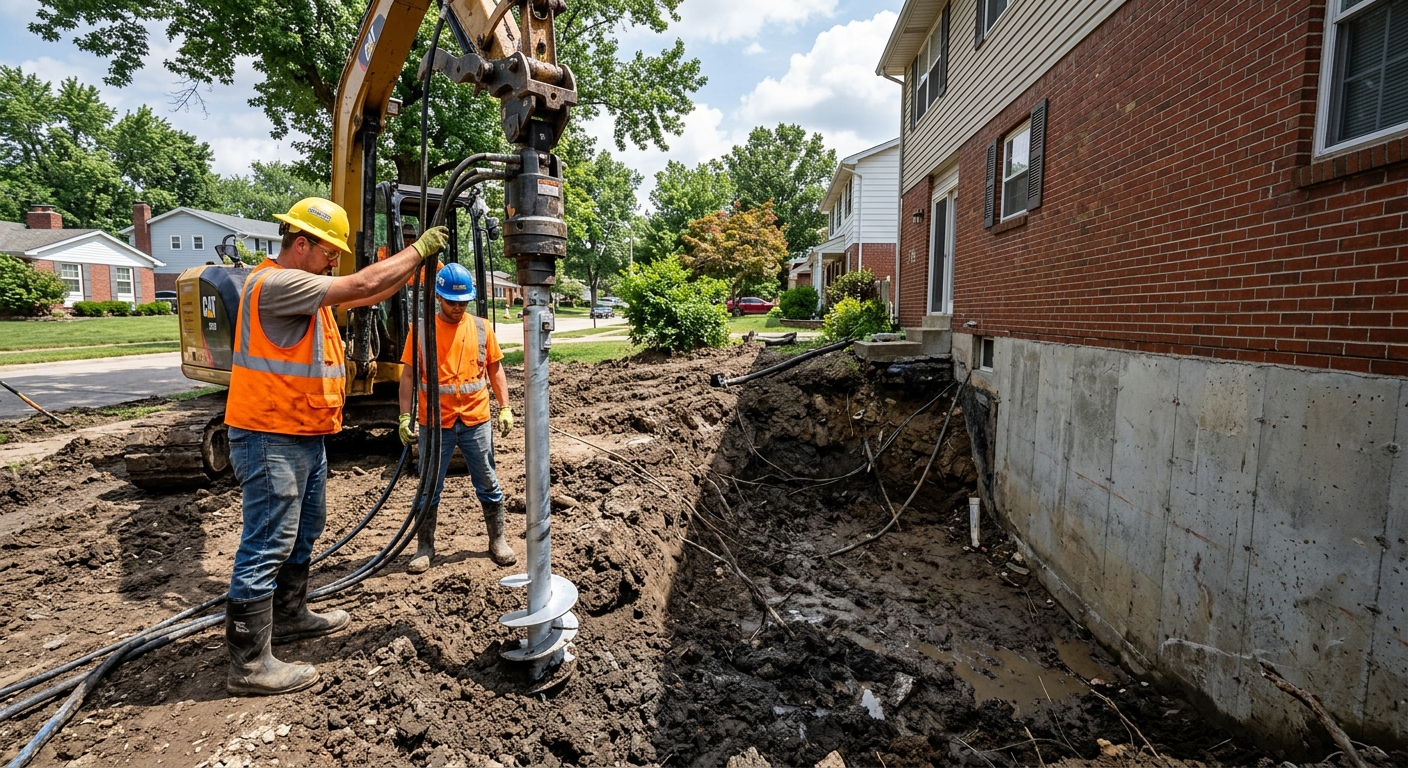
Helical pier foundation repair uses engineered steel shafts with helical plates—similar to large screws—that are hydraulically driven deep into the ground until they reach stable, load-bearing soil or bedrock. Unlike surface-level repairs that only mask foundation problems temporarily, helical anchors create a permanent structural connection between your home's foundation and stable earth strata located 20 to 80 feet below grade, depending on local soil conditions. This technology has been used in commercial construction and bridge stabilization for over a century, and it's now the gold standard for residential foundation repair in areas with challenging soil conditions like those found throughout St. Louis and the greater Missouri region.
The helical pier system works by transferring the weight of your home away from unstable surface soil and onto deep, competent soil layers that don't shift with seasonal moisture changes. Each pier is installed individually and tested for load capacity before your foundation is lifted and stabilized, ensuring engineered precision rather than guesswork. The result is a foundation repair that stops ongoing settlement, prevents future structural damage, and often allows for controlled lifting to close cracks and restore doors and windows to proper operation.
How Helical Anchors Stabilize Settling Foundations
Helical anchors stabilize settling foundations through a principle called deep foundation load transfer. When expansive clay soil beneath your home swells during wet seasons and shrinks during dry periods, it creates uneven support that causes your foundation to crack, tilt, or sink. Our helical foundation anchors bypass this problematic surface layer entirely by extending through the unstable clay until the helical plates engage with dense, stable soil or bedrock that maintains consistent load-bearing capacity year-round.
- Multi-helix design: Each pier shaft features multiple helical plates spaced along its length, distributing weight across a larger soil volume and preventing single-point failure
- Immediate load transfer: Unlike concrete piers that require curing time, helical piers transfer structural loads immediately upon installation and bracket attachment
- Adjustable depth: Pier sections are added during installation until torque readings confirm the anchor has reached stable bearing strata—depths commonly range from 15 to 60 feet in St. Louis
- Controlled lift capability: Hydraulic lift cylinders allow our technicians to raise your foundation back toward level in measured increments, closing cracks and restoring structural integrity
- Permanent stabilization: Once installed and load-tested, helical anchors provide decades of reliable support with transferable warranties that protect your investment and increase home value
The process begins with a detailed foundation inspection and soil assessment to determine the optimal pier placement and required depth. Our engineers calculate the exact load each pier must carry based on your home's weight distribution, soil conditions, and the extent of existing settlement. This engineering-first approach ensures your foundation repair is sized correctly from day one—you're not paying for unnecessary piers, and you're not left vulnerable to future failure from underdesigned solutions.
Why Helical Piers Outperform Concrete & Push Piers in Clay Soil
St. Louis sits atop expansive Maquoketa clay that can swell up to 10% during wet seasons and shrink significantly during drought, creating a soil environment where traditional concrete piers and even push piers often fail to deliver long-term stability. Concrete piers are typically poured to depths of only 6 to 10 feet—well within the active zone of seasonal soil movement—meaning they settle right along with the soil they're supposed to stabilize. Push piers, while deeper than concrete, rely on the weight of your existing home to drive them into the ground and can't achieve the verified torque-to-capacity relationship that helical anchors provide through mechanical installation.
- Verified load capacity: Helical piers are installed using hydraulic torque motors that measure rotational resistance in real-time; when installation torque reaches 3,000 to 5,000 ft-lbs (depending on pier diameter and soil type), we know the anchor has engaged competent bearing soil and can calculate exact load capacity using established engineering formulas
- Installation in any soil condition: Helical anchors can be installed year-round regardless of soil moisture content, while concrete pier installation is compromised by wet conditions and push piers may not achieve proper depth in extremely dry, hard clay
- No soil excavation spoils: The helical installation process displaces minimal soil—no large piles of clay to haul away, no destruction of landscaping, and no weakening of adjacent soil through excavation disturbance
- Adjustability and precision: Each helical pier can be individually adjusted during installation to achieve level support across your entire foundation, while concrete piers are fixed at the height they're poured
For St. Louis homeowners dealing with the unique challenges of Midwest clay soil, helical pier foundation repair offers engineering certainty that surface-level solutions simply cannot match. If you're comparing foundation repair options, ask contractors to show you their torque installation data and explain how deep their piers will reach in your specific soil conditions—this transparency separates engineered solutions from guesswork.
Helical Foundation Anchors: The Core Technology
Helical foundation anchors are precision-engineered steel foundation support systems consisting of a central shaft (typically 1.5 to 2.875 inches in diameter) with one or more helical bearing plates welded at calculated intervals along the shaft length. These bearing plates function like threads on a screw, cutting into the soil as the anchor is rotated into the ground and creating continuous contact with stable bearing strata once installation depth is reached. The technology behind helical anchors is based on soil mechanics principles that have been refined and validated through decades of use in commercial construction, utility infrastructure, and military applications where foundation failure is not an option.
What makes helical foundation anchors superior for residential foundation repair is their ability to be installed with mathematical precision and verified performance. Every anchor installed on your property is load-tested according to ICC-ES AC358 standards, and installation torque data is recorded to create a permanent record of your foundation repair's load-bearing capacity. This engineering documentation becomes part of your home's permanent record and can be transferred to future buyers, adding measurable value to your property.
How Helical Anchors Transfer Load to Stable Soil
The load transfer mechanism of helical anchors relies on the bearing capacity of native soil at depth rather than relying on friction along the pier shaft (as push piers do) or on the structural integrity of poured concrete. When your home's weight presses down on the foundation, that force is transmitted through a steel bracket attached to your foundation footing, down the helical pier shaft, and into the helical bearing plates that are embedded in stable soil layers. The plates act as bearing surfaces that distribute your home's weight across a larger soil area, preventing the concentrated stress that causes point-loading failures in other pier systems.
- Plate configuration: Piers may have one, two, or three helical plates depending on required load capacity; multi-helix designs distribute weight across multiple soil horizons for redundancy and higher capacity
- Bracket connection: Heavy-duty steel foundation brackets are custom-fitted to your existing footing and attached to the pier shaft with structural bolts, creating a rigid connection that prevents differential movement
- Shaft extensions: As the lead section reaches capacity depth, extension sections are coupled to the shaft and installation continues until all plates are seated in competent bearing soil
- Soil displacement: Unlike auger-cast piles that remove soil, helical piers displace soil radially and compact it around the shaft, actually increasing soil density and bearing capacity in the immediate pier zone
Torque Verification & Load Capacity Testing
One of the most important advantages of helical anchor installation is real-time torque monitoring that provides immediate verification of load capacity without waiting for concrete to cure or relying on assumptions about soil conditions. Our installation equipment includes calibrated torque sensors that measure the rotational resistance encountered by the anchor as it advances into the ground. When installation torque reaches the target range specified by our engineers—typically 3,000 to 5,000 ft-lbs for residential applications—we know the helical plates have engaged stable, load-bearing soil.
The relationship between installation torque and load capacity is governed by well-established empirical formulas that correlate torque readings to ultimate bearing capacity. For example, a helical pier installed to 4,000 ft-lbs of torque in dense clay can typically support 30,000 to 40,000 pounds of structural load with appropriate safety factors applied. This torque-to-capacity relationship is documented for each pier installed on your property, and you receive a permanent record showing the location, depth, final torque, and calculated capacity of every anchor in your foundation repair system.
- Installation torque monitoring: Hydraulic pressure gauges or electronic torque sensors provide continuous feedback during installation, ensuring each pier reaches verified bearing strata
- Torque correlation formulas: Industry-standard equations (based on helix diameter, shaft diameter, and soil type) convert installation torque into allowable load capacity with appropriate factors of safety
- Load testing protocols: Critical piers may be proof-tested by applying hydraulic loads exceeding design requirements and measuring deflection to confirm performance
- Quality documentation: Every helical pier installation includes a final report with pier locations, installation depths, torque readings, and calculated capacities—documentation that satisfies building inspectors, engineers, and future home buyers
Anchor Depth & Soil Bearing Capacity
The depth to which helical anchors must be installed depends entirely on local soil conditions and the depth at which stable, load-bearing soil or bedrock is encountered. In St. Louis and surrounding areas, stable bearing strata are typically found at depths ranging from 15 to 60 feet below grade, depending on your specific location and proximity to the Mississippi or Missouri River flood plains. Our foundation repair projects begin with soil boring data or historical soil surveys for your neighborhood to estimate the anticipated depth to competent bearing soil, but the actual installed depth is determined on-site through torque monitoring.
Soil bearing capacity—the ability of soil to support structural loads without excessive settlement—varies dramatically by soil type and depth. The upper 10 to 15 feet of St. Louis soil typically consists of expansive clay with low, variable bearing capacity (1,000 to 2,000 pounds per square foot), while deeper strata may include dense glacial till, weathered shale, or limestone bedrock with bearing capacities exceeding 4,000 pounds per square foot. Helical foundation anchors work precisely because they bypass the problematic surface layer and engage with these deeper, stable formations.
- Site-specific depth determination: Installation continues until torque readings indicate stable bearing soil has been reached—this may occur at 20 feet at one corner of your home and 45 feet at another corner due to variations in subsurface geology
- Extension shaft sections: Helical piers are installed in sections (typically 5, 7, or 10 feet long) that are coupled together as installation progresses, allowing unlimited depth capacity
- Refusal depth: Installation proceeds until "refusal"—the point at which further advancement requires torque exceeding equipment capacity or until bedrock is encountered, confirming the pier has reached maximum bearing capacity
- Clay layer penetration: In St. Louis, penetrating through the active Maquoketa clay layer and into underlying dense materials is essential for permanent foundation stabilization—shallow repairs that remain within the clay zone will fail as soil moisture cycles continue
Helical Pier Foundation Repair in St. Louis: Local Soil Conditions
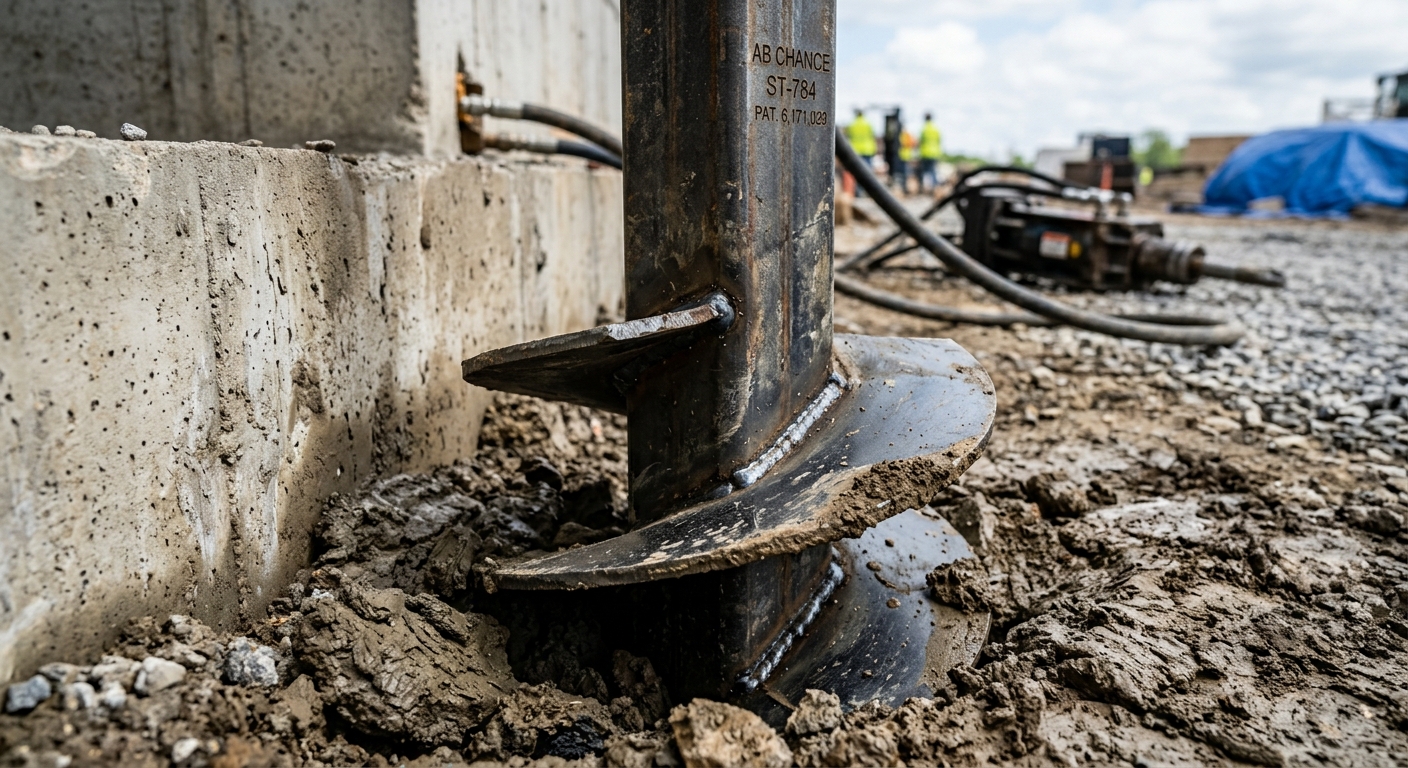
Helical anchors foundation repair St. Louis projects must account for the unique geological challenges presented by our region's expansive clay soil, seasonal moisture fluctuations, and freeze-thaw cycles that create some of the most aggressive foundation conditions in the Midwest. St. Louis sits within the Central Lowlands physiographic province, characterized by thick deposits of glacial clay overlying Paleozoic bedrock formations, and this specific soil profile creates foundation problems that demand deep-pier solutions rather than surface-level repairs.
Our team has completed hundreds of foundation repair projects throughout St. Louis, St. Charles County, Jefferson County, and surrounding Missouri communities, and we've developed installation protocols specifically calibrated to local soil conditions. We understand that a foundation repair strategy that works in sandy Florida soil or rocky Colorado terrain will fail in St. Louis clay—and we engineer every helical pier installation to deliver permanent stability in the soil conditions we encounter every day in this region.
Maquoketa Clay & Expansive Soil Movement
The Maquoketa Formation is a geological unit of clay-rich shale and limestone that underlies much of the St. Louis metropolitan area and plays a central role in the foundation problems local homeowners experience. When exposed near the surface through weathering, Maquoketa clay exhibits high plasticity and expansion potential—it can absorb significant moisture and swell up to 10% in volume during wet seasons, then shrink back during dry periods. This cyclical expansion and contraction creates enormous upward and downward pressures on foundations, causing cracks, uneven settling, and structural distress that worsens over time if not addressed with deep foundation stabilization.
- Seasonal moisture cycles: St. Louis receives approximately 42 inches of annual precipitation with distinct wet (spring) and dry (late summer) periods that drive soil expansion and shrinkage cycles—your foundation experiences these stress cycles twice per year, every year
- Clay mineralogy: Maquoketa clay contains smectite and illite clay minerals that have high cation exchange capacity and affinity for water molecules, causing them to expand dramatically when wet and contract when dry
- Active zone depth: The "active zone" where seasonal moisture changes affect soil volume typically extends 8 to 15 feet below grade in St. Louis—any foundation repair solution that doesn't extend below this depth will move with the soil rather than stabilizing it
- Differential movement: Because soil moisture content varies across your property (due to drainage patterns, tree root activity, and sun exposure), different areas of your foundation experience different amounts of swelling and shrinking—this differential movement is what creates the diagonal cracks and uneven floors characteristic of expansive clay foundation damage
Helical pier foundation repair solves the expansive clay problem by extending support deep below the active zone where soil moisture content remains relatively constant year-round. By anchoring your foundation to stable soil at 20, 40, or even 60 feet of depth, we eliminate the seasonal movement cycle that causes ongoing foundation damage.
Why St. Louis Foundations Need Deep Pier Installation
Foundation repair solutions that rely on shallow installation depths—including most concrete pier systems, mudjacking, and slabjacking—fail in St. Louis because they remain within the active zone of soil movement rather than bypassing it. A concrete pier poured to 8 feet of depth may temporarily lift a settling foundation, but it's still sitting in expansive clay that will continue to swell and shrink with seasonal moisture changes. Within 3 to 5 years, these shallow repairs often fail and require re-repair, costing homeowners thousands of dollars in repeated foundation work.
Deep pier installation using helical anchors addresses the root cause of foundation failure by transferring structural loads to soil strata that don't experience seasonal volume changes. In most St. Louis locations, stable bearing soil is found at depths of 15 to 40 feet, though areas near river valleys or former wetlands may require installation to 50 or 60 feet to reach competent material. Our helical underpinning system is specifically designed to reach these depths efficiently and economically, with installation equipment capable of driving p
Helical Pier Foundation Repair Cost in St. Louis
Helical pier foundation repair in St. Louis runs $1,200 to $1,800 per pier installed. The pier count, not the per-pier rate, is what moves the total: localized settlement under one corner or a short wall section usually needs 4 to 8 piers, while full perimeter stabilization on an average home needs 8 to 12. That puts most projects between $5,000 and $22,000, with the number of piers fixed by how much of the foundation has moved rather than by the size of the house.
- Helical pier installed, including bracket and load test: $1,200–$1,800 per pier
- Localized settlement, one corner or a short wall run: 4–8 piers
- Full perimeter stabilization: 8–12 piers
- Engineering report where a stamped drawing is required: $500–$800
- Restoration of landscaping and interior finishes: add 15–20% to the structural figure
Three things change the per-pier price on a St. Louis property. Depth comes first — piers are driven until torque confirms stable bearing soil, which happens at 15 feet on some lots and 60 feet on others, and deeper piers carry more shaft. Access comes second, because a pier installed in an open side yard costs less in labour than one reached through a narrow passage. Load comes third: a heavier masonry home needs higher capacity per pier than a frame house of the same footprint.
The Helical Pier Installation Process, Step by Step
Helical pier installation on a St. Louis home takes one to two days for a typical job. The sequence below is what happens on site, and every stage produces a number that appears on the completion paperwork.
- Inspection and pier layout. A technician measures elevations across the floor, records crack widths and locations, and marks pier positions along the failing section. Spacing follows the load each pier must carry.
- Excavation at each pier location. Compact excavations expose the foundation footing. Work is external wherever access allows, which keeps the basement usable.
- Bracket installation. A heavy steel foundation bracket is fixed to the underside of the footing. The bracket is what transfers the home's weight into the pier.
- Driving the pier. A hydraulic torque motor rotates the helical shaft into the ground. Torque is monitored continuously; when it reaches the engineered target of 3,000 to 5,000 ft-lbs, the helical plates have engaged stable bearing soil. Depth is whatever that takes — commonly 15 to 60 feet in this region, and it varies from one corner of a home to another.
- Load transfer and lift. Hydraulic cylinders transfer the load onto the piers. Where lift is achievable, the foundation is raised in measured increments across all piers at once, closing cracks as the structure returns toward level.
- Verification and backfill. Each pier's final torque and depth are recorded, excavations are backfilled and compacted, and the site is restored.
Torque monitoring is what separates a helical pier from a guess. A pier installed to 4,000 ft-lbs in dense clay supports 30,000 to 40,000 pounds of structural load once safety factors are applied, and that figure is measured at installation rather than assumed. The completed installation carries a warranty against failure for as long as you own the home, transferable to a buyer.
Frequently Asked Questions
How much does helical pier foundation repair cost in St. Louis?
Helical pier foundation repair costs $1,200 to $1,800 per pier installed in St. Louis. Localized settlement under one corner needs 4 to 8 piers; full perimeter stabilization needs 8 to 12. Most projects land between $5,000 and $22,000. The free inspection fixes the pier count, so the estimate states the exact number of piers, the depth each will be driven and the cost per pier before any work is scheduled.
How deep are helical piers driven?
Helical piers in the St. Louis area are commonly driven 15 to 60 feet. Depth is not chosen in advance — installation continues until the hydraulic torque motor reads the engineered target of 3,000 to 5,000 ft-lbs, which confirms the helical plates have engaged stable bearing soil. Subsurface geology varies across a single property, so one corner of a home may reach stable strata at 20 feet while another needs 45.
How long does helical pier installation take?
A typical helical pier installation takes one to two days. Each pier is excavated, bracketed, driven to its torque target and load-tested in sequence, and lift is performed across all piers together once they are in place. Larger perimeter jobs of 10 to 12 piers run toward the upper end. Weather affects exterior excavation, particularly during Missouri winters.
Which is right for my home, helical piers or push piers?
Neither method is better in every case — they suit different homes. Helical piers are screwed in with a torque motor, which produces a measured load capacity at installation and generates far less noise and vibration, making them suited to lighter structures, crawl space foundations, localized settlement and occupied homes. Push piers are driven using the home's own weight as resistance, which suits heavier masonry structures and severe settlement. Push piers cost $1,300 to $2,000 per pier against $1,200 to $1,800 for helical.
Can helical piers lift my foundation back to level?
Yes, in most cases, though not every foundation returns fully to its original elevation. Hydraulic cylinders raise the foundation in measured increments once the piers carry the load, and cracks close as the structure returns toward level. Full restoration of original elevation depends on how long the settlement has been active and how much the structure has distorted — a foundation that has moved for years may lift partially rather than completely. Stabilization against further movement is achieved in every correctly installed case.
Do helical piers work in St. Louis clay soil?
Yes. Expansive clay is exactly the condition helical piers are designed to bypass. The clay shrinks and swells with seasonal moisture, so any repair that stays within that active layer moves with it. Helical piers extend through the clay until the plates engage dense, stable material that holds consistent bearing capacity year-round. Clay's cohesive properties also give the helical plates strong bearing resistance once engaged.
Will helical pier installation damage my yard or driveway?
No. Disruption is limited: each pier needs a compact excavation beside the foundation rather than continuous trenching, and installation equipment is small enough to reach most side yards. Excavations are backfilled and compacted and the site restored on completion. Landscaping and interior cosmetic restoration typically adds 15 to 20 percent to the structural repair figure, and that allowance appears on the estimate.
Is helical pier foundation repair covered by a warranty?
Yes. Helical pier installations carry warranty coverage against failure for as long as you own the home, and the coverage transfers to the buyer if you sell. Each pier's final installation torque and depth are recorded, which gives the documented load verification that mortgage lenders, home inspectors and title companies look for during a St. Louis property transaction.
Book your free foundation inspection
Tell us what you are seeing and where the home is. The inspection is free, there is no obligation, and you get a written estimate showing the repair method, the number of piers or anchors and the total before anything is scheduled.