Polyurethane foam injection cost in St. Louis typically ranges from $5 to $25 per square foot, depending on the size of the void beneath your slab and the extent of concrete settlement. This proven method lifts sunken driveways, patios, sidewalks, and foundation slabs in a single day—no messy slurry, no 48-hour waiting period, and no recurring repairs in three years. Our polyurethane foam injection system delivers permanent concrete lifting for St. Louis property owners dealing with expansive clay soil that causes recurring settlement. You get a lightweight, waterproof foam that cures in 15 minutes and handles vehicle loads the same day we finish the job.
Polyurethane Foam Injection Cost: Pricing Breakdown for St. Louis
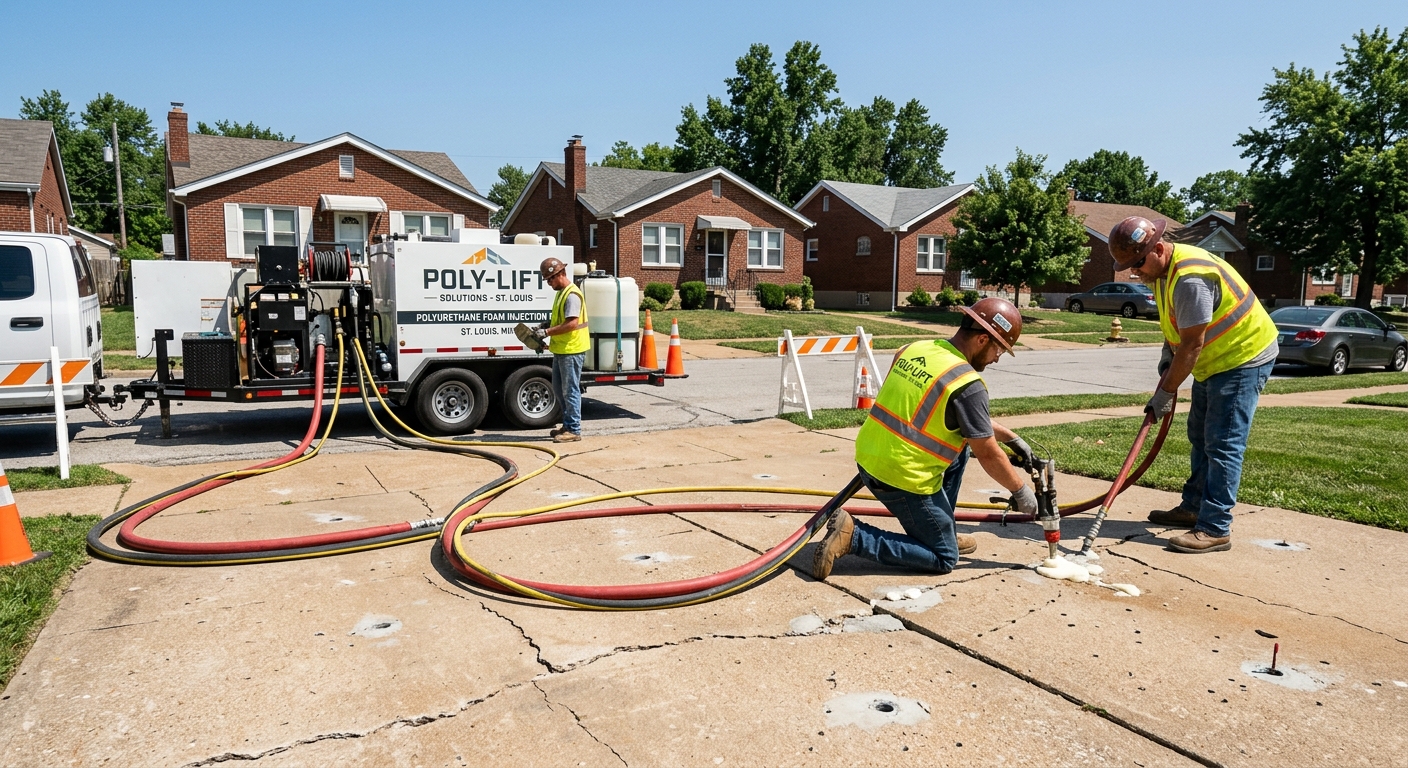
Polyurethane foam injection cost depends on three primary factors: the square footage of the sunken slab, the depth of the void beneath it, and accessibility for our injection equipment. Most residential projects in St. Louis fall between $800 and $4,500, with commercial jobs running higher based on scale. You're paying for precision-engineered foam that expands to fill voids, lifts your concrete to exact grade, and prevents future settlement—all in one visit.
Cost Per Square Foot: Standard Rates for Slab Jacking Projects
Standard polyurethane foam injection cost runs $5 to $25 per square foot in the St. Louis metro area. Small repairs—like a 50-square-foot patio section—often land at the higher end of the range because mobilization costs apply regardless of project size. Larger driveways and commercial slabs benefit from economies of scale, bringing the per-square-foot price down. Deeper voids require more foam volume, which increases material cost but still undercuts the long-term expense of repeated mudjacking repairs.
- Shallow voids (1-2 inches): $5-$10 per square foot
- Moderate settlement (2-4 inches): $10-$18 per square foot
- Deep voids or foundation lifting (4+ inches): $18-$25 per square foot
- Minimum service charge: $800-$1,200 for projects under 100 square feet
- Commercial projects: custom quotes based on load requirements and accessibility
The foam we inject weighs just 2-4 pounds per cubic foot—98% lighter than traditional mudjacking slurry—so your soil bears almost no additional load. In St. Louis's expansive clay conditions, this weight difference makes polyurethane the only slab jacking method that doesn't trigger re-settling. Call (314) 798-9554 for a free measurement and exact quote.
Project-Size Cost Examples: Driveway, Patio & Foundation Repair
A 200-square-foot two-car driveway with moderate settlement (2-3 inches) typically costs $2,000 to $3,200 in St. Louis. A 100-square-foot patio slab with minor corner drop runs $800 to $1,500. Foundation slab lifting—like a sunken garage floor or basement slab—averages $3,500 to $6,500 for a standard 400-square-foot area, depending on how much foam volume we need to stabilize the void and prevent future shifting.
- Single-car driveway (100 sqft, 2" settlement): $1,200-$1,800
- Two-car driveway (200 sqft, 3" settlement): $2,000-$3,200
- Patio or sidewalk section (50-100 sqft): $800-$1,500
- Garage floor (300 sqft, moderate voids): $2,800-$4,500
- Full foundation perimeter stabilization (500+ sqft): $5,000-$9,000
These examples reflect typical St. Louis jobs completed between 2023 and 2026. Your actual polyurethane foam injection cost depends on site-specific conditions—our team provides free on-site inspections and binding quotes before we start work.
Factors That Affect Polyurethane Foam Injection Cost
Void depth is the biggest cost driver: deeper voids require more foam to fill the space and generate sufficient lifting pressure. Slab thickness matters too—6-inch reinforced concrete needs more lift capacity than a 4-inch residential patio. Accessibility affects pricing: tight spaces or slabs blocked by landscaping require smaller injection ports and slower application, increasing labor time. St. Louis properties with poor drainage or ongoing erosion may need additional foam volume to stabilize shifting soil beneath the slab.
- Void depth: Deeper voids = more foam volume = higher material cost
- Slab thickness & reinforcement: Heavier slabs require stronger foam density
- Accessibility: Fenced backyards, tight gate access, or landscaping obstacles add setup time
- Soil stability: Ongoing erosion or poor drainage may require supplemental foam injection
- Project urgency: Same-day or emergency service available at premium rates
Our free inspection identifies all cost factors upfront—no surprises, no change orders. We measure the void with ground-penetrating radar, assess slab condition, and provide a detailed written estimate the same day. Contact our St. Louis slab jacking team at (314) 798-9554 to schedule your inspection.
Polyurethane Slab Jacking in St. Louis: Local Service Details
Polyurethane slab jacking in St. Louis addresses the metro area's unique soil challenges: expansive montmorillonite clay that swells when wet and shrinks when dry, creating voids beneath concrete slabs. Unlike mudjacking slurry—which adds 100+ pounds per cubic foot of additional load—polyurethane foam weighs almost nothing, preventing the soil compression that causes repeated settlement. We've completed 500+ successful slab lifting projects across St. Louis County, St. Charles County, and Metro East Illinois, with same-day load bearing on every job.
Why St. Louis Clay Soil Requires Lightweight Foam Solutions
St. Louis sits on clay-rich soil deposits that contain smectite minerals—these clays absorb water and expand up to 10% in volume during wet seasons, then contract during summer droughts. This seasonal cycle creates voids beneath concrete slabs as the soil pulls away. Traditional mudjacking fills those voids with heavy slurry that compresses the already unstable clay, triggering a second round of settling within 3-5 years. Polyurethane foam eliminates this cycle: the foam weighs 2-4 pounds per cubic foot and cures into a waterproof, chemically inert solid that won't erode or compress the soil beneath it.
- St. Louis receives 40+ inches of annual rainfall, creating constant wet-dry soil cycles
- Expansive clay soil causes 60% of residential foundation and slab settlement in the metro area
- Mudjacking slurry adds enough weight to re-compress clay soil within 3-5 years
- Polyurethane foam's negligible weight prevents re-settling and lasts 10-15+ years
- Waterproof foam won't wash out during St. Louis's heavy spring storms
Our foam remains stable through freeze-thaw cycles, summer heat, and the soil movement St. Louis property owners deal with year after year. If you're tired of re-leveling the same slab every few years, polyurethane slab jacking delivers the permanent fix you need.
St. Louis Neighborhoods We Serve: Same-Day Quotes Available
We provide polyurethane foam injection services throughout the greater St. Louis metro area, including Clayton, Webster Groves, Kirkwood, Chesterfield, O'Fallon, St. Charles, Belleville, and Edwardsville. Our team operates from a central St. Louis location, allowing us to reach most properties within 45 minutes for emergency repairs or scheduled inspections. We know the soil conditions in each neighborhood—from the heavy clay in South County to the loess deposits in West County—and adjust foam density and injection patterns accordingly.
- St. Louis County: Clayton, University City, Kirkwood, Webster Groves, Affton, Mehlville
- St. Charles County: St. Charles, O'Fallon, St. Peters, Wentzville, Lake St. Louis
- Metro East Illinois: Belleville, O'Fallon IL, Collinsville, Edwardsville, Glen Carbon
- City of St. Louis: Central West End, Soulard, Tower Grove, The Hill, Dogtown
Call (314) 798-9554 to confirm service in your area and schedule a free on-site inspection. We provide same-day quotes for most residential projects and can mobilize within 24-48 hours once you approve the estimate.
Local Permit & Code Requirements for Slab Jacking
Most St. Louis County municipalities do not require permits for non-structural slab lifting projects like driveways, patios, and sidewalks. Foundation slab repairs—especially those involving load-bearing basement floors or garage slabs attached to the home's structural footing—may require a building permit and inspection in cities like Clayton, Ladue, and Kirkwood. We handle permit applications and coordinate inspections on your behalf at no additional charge. HOA-governed communities sometimes require written approval before exterior concrete work; we provide documentation and photos to streamline that process.
- Non-structural slabs (driveways, patios, walkways): typically no permit required
- Foundation slabs and load-bearing floors: permit required in most St. Louis County cities
- We handle all permit paperwork, inspections, and HOA documentation
- Licensed and bonded contractors meet all St. Louis County and Missouri state requirements
Our team stays current on local code updates and works directly with city inspectors to ensure compliance. You get peace of mind knowing your slab lifting project meets all regulatory standards.
Foam Jacking for Foundation Repair: When It Works Best
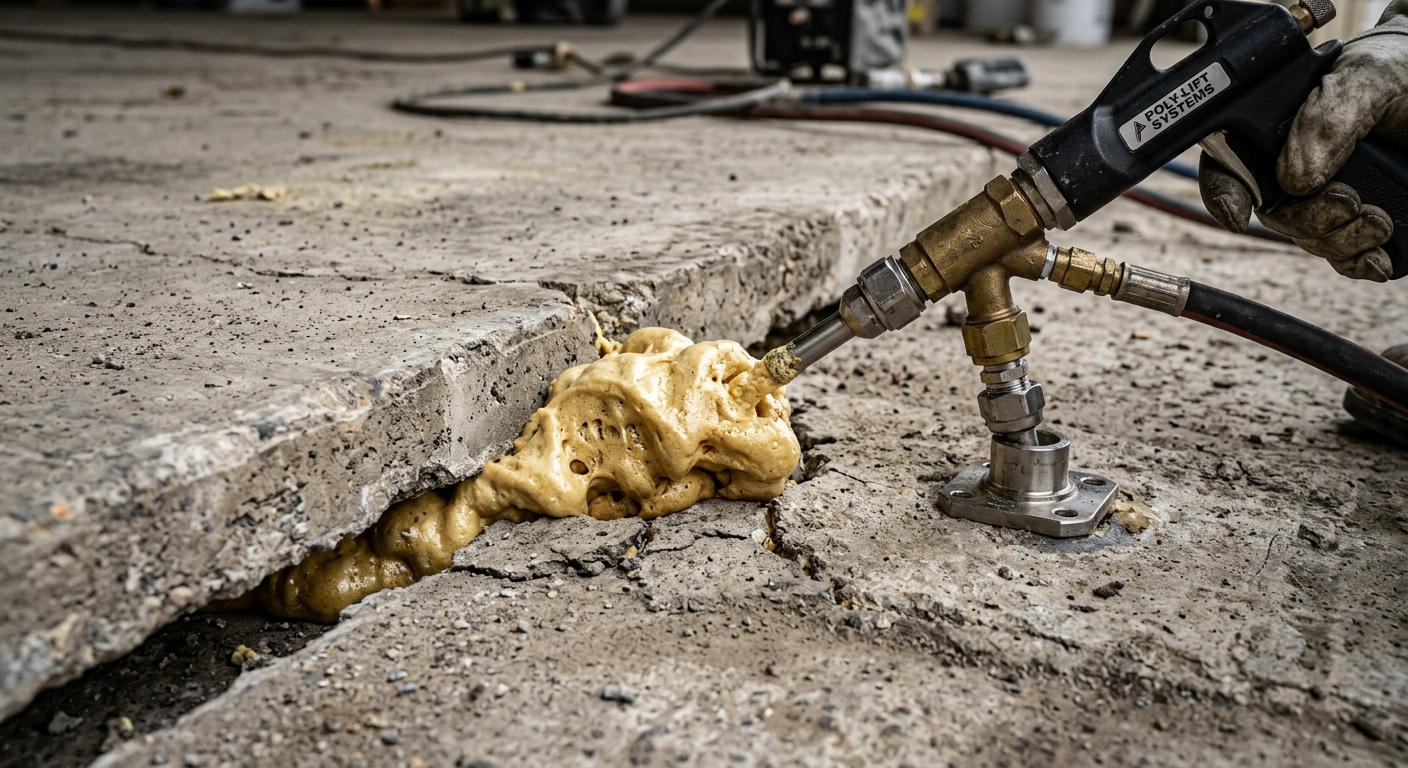
Foam jacking for foundation repair solves slab subsidence caused by soil erosion or consolidation beneath your basement floor, garage slab, or foundation footing. If your foundation has settled evenly—creating a level but sunken slab—polyurethane foam lifts it back to grade without excavation or structural underpinning. For uneven settlement or structural cracks caused by soil bearing failure, you need helical piers or push piers to stabilize the footing before we inject foam. Our free inspection identifies which solution your foundation needs.
Foundation Settlement vs Slab Subsidence: Which Needs Polyurethane
Foundation settlement occurs when the soil beneath your home's footing fails, causing structural cracks, sticking doors, and uneven floors throughout the house. Slab subsidence is localized: your basement floor, garage slab, or front stoop sinks because soil eroded or consolidated beneath it, but the home's structural footing remains stable. Polyurethane foam injection fixes slab subsidence—it lifts the concrete back to grade and fills the void to prevent future dropping. Structural foundation settlement requires piering to stabilize the footing first, then foam to lift and level the slab.
- Slab subsidence (polyurethane works): garage floor sinking, basement slab dipping, front stoop dropping—slab is level but low
- Foundation settlement (piering required): cracks in walls, sticking doors, sloped floors—structural footing is failing
- Polyurethane foam costs $5-$25/sqft; helical piers run $1,200-$1,800 per pier installed
- Combination projects: stabilize footing with piers, then lift slab with foam
We use laser levels and foundation monitoring tools to distinguish slab issues from structural settlement. If your foundation needs piers, we provide a comprehensive quote covering both piering and foam lifting concrete in one project scope.
Cost Comparison: Foam Jacking vs Piering for Foundations
Polyurethane foam jacking costs $5-$25 per square foot and solves slab subsidence in one day. Helical pier installation runs $1,200-$1,800 per pier (most homes need 6-12 piers for perimeter stabilization), totaling $10,000-$20,000+ for structural foundation repair. If your foundation requires both piering and slab lifting, we coordinate the work in sequence: install piers to stabilize the footing, then inject foam to lift the slab back to grade. This combined approach costs less than replacing the foundation and delivers a permanent fix in 2-3 days.
- Polyurethane foam jacking: $2,000-$6,500 for typical basement or garage slab (200-400 sqft)
- Helical pier installation: $10,000-$20,000 for perimeter foundation stabilization
- Combined pier + foam project: $12,000-$25,000 depending on home size and settlement severity
- Full foundation replacement: $30,000-$60,000+ with 4-6 weeks of construction disruption
Foam jacking for foundation slabs delivers 80-90% cost savings compared to full replacement and gets your basement or garage back in service the same day. Call (314) 798-9554 for a free foundation assessment and cost comparison.
How Polyurethane Foam Prevents Future Foundation Shifting
Polyurethane foam hardens into a waterproof, chemically inert solid that won't erode, compress, or wash out—even in St. Louis's wet spring and fall seasons. The foam fills 100% of the void space beneath your slab, eliminating the air pockets and loose soil that allow continued settlement. Because the foam weighs just 2-4 pounds per cubic foot, it adds almost no load to the already compromised soil beneath your foundation. This prevents the re-compression cycle that mudjacking triggers, where the weight of the slurry causes the soil to consolidate further and the slab to sink again in 3-5 years.
- Waterproof foam won't erode during heavy rains or basement flooding events
- Chemically inert formula resists soil acids, fertilizers, and groundwater contamination
- Negligible weight prevents re-compression of clay soil beneath the slab
- Manufacturer warranties cover foam performance for 10-15 years in most applications
- Foam bonds to the underside of your slab, creating a unified structure that moves as one unit
Once we inject and cure the foam, your foundation slab remains stable through seasonal soil movement, freeze-thaw cycles, and drainage changes. You get a one-time fix that outlasts mudjacking by a decade or more.
How Polyurethane Lifting Concrete Works: The Injection Process
Polyurethane lifting concrete uses a two-component expanding foam injected through 5/8-inch holes drilled in your slab. The foam expands within seconds, filling voids and generating upward pressure that lifts the concrete back to grade. The entire process—drilling, injection, and leveling—takes 2-4 hours for most residential driveways and patios. The foam cures in 15 minutes and reaches full load-bearing strength within one hour, allowing you to drive on your driveway or walk on your patio the same day we finish.
Step-by-Step: Injection, Expansion & Curing Time
We start by drilling 5/8-
Frequently Asked Questions
What Is Polyurethane Foam Injection and How Does It Work?
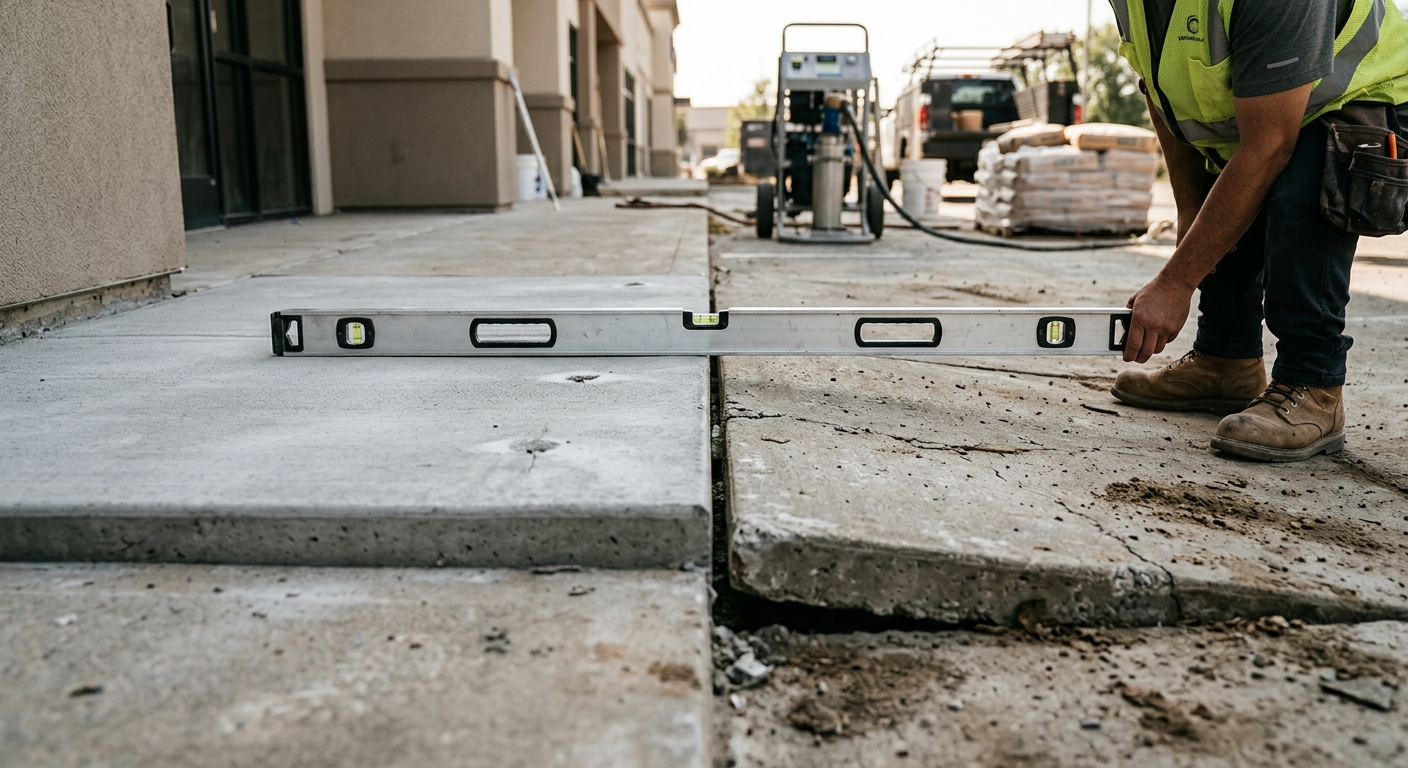
Polyurethane foam injection is a modern concrete lifting technique used throughout St. Louis to repair sunken slabs, driveways, and foundation issues. A technician drills small holes into the affected concrete, then injects expanding polyurethane foam beneath the surface. The foam expands within seconds, filling voids and lifting the slab back to its original level. The process typically takes 1–3 hours depending on the area size, and the concrete is ready for full use within 15 minutes of completion.
What is Polyurethane Foam Injection?
Polyurethane foam injection is a lightweight, high-density foam solution designed to stabilize and lift settled concrete. Unlike traditional mudjacking that uses heavy cement slurry, polyurethane foam weighs just 2–4 pounds per cubic foot, reducing future settlement risk. The two-part chemical mixture reacts and expands underground, permanently filling soil gaps and raising concrete surfaces. This method is widely used in Missouri for foundation repair, sidewalk leveling, garage floors, and driveway restoration due to its precision and minimal disruption.
What Factors Affect the Cost of Foam Injection?
Several factors influence polyurethane foam injection costs in St. Louis. The size of the sunken area directly impacts material and labor expenses—larger driveways or patios require more foam. Depth of voids beneath the concrete also matters; deeper settlement needs additional foam volume. Accessibility plays a role; areas requiring equipment relocation or challenging terrain increase costs. Severity of cracking or damage may require additional prep work. Most St. Louis foundation repair projects range from $500 for small repairs to $3,500 for extensive concrete lifting work.
How Much Does Foam Injection Actually Cost?
Polyurethane foam injection in St. Louis typically costs between $5 and $25 per square foot, depending on project complexity and slab thickness. Small residential repairs like sidewalk panels average $400–$800, while driveway leveling ranges from $1,200–$2,500. Foundation slab stabilization projects run $1,500–$5,000 based on square footage and void depth. These prices include drilling, foam injection, hole sealing, and cleanup. Most contractors offer free inspections and quotes, allowing homeowners to compare pricing before committing to repairs.
Which Option Offers the Best Long-Term Value?
Polyurethane foam injection delivers superior long-term value compared to mudjacking or concrete replacement in Missouri. The foam is waterproof and won't erode or wash out during heavy rains, common in the St. Louis region. Its lightweight nature prevents additional soil compression, reducing re-settlement risk. While upfront costs run 20–30% higher than traditional mudjacking, polyurethane lasts 10–15 years longer with proper drainage maintenance. Concrete replacement costs 3–5 times more and requires extensive demolition, making foam injection the most cost-effective solution for settled slabs.
Is It an Eco-Friendly Choice?
Polyurethane foam injection is considered environmentally responsible for several reasons. It eliminates concrete demolition waste that would otherwise fill landfills—a single driveway replacement generates 2–4 tons of debris. The foam itself is inert once cured, releasing no harmful chemicals into Missouri soil or groundwater. Installation requires minimal equipment, reducing carbon emissions compared to concrete mixing trucks and removal vehicles. The process preserves existing materials rather than consuming new cement, aggregate, and water. Many foam formulations now incorporate recycled content, further reducing environmental impact.
How quickly can polyurethane foam injection be completed in St. Louis?
Most polyurethane foam injection projects in St. Louis are completed within 2–4 hours from start to finish. Small repairs like porch steps or single sidewalk panels take 30–60 minutes. Driveway leveling typically requires 2–3 hours depending on square footage and number of settled sections. The foam cures in just 15 minutes, allowing immediate foot traffic and vehicle use the same day. This speed advantage makes foam injection ideal for commercial properties and busy homeowners who cannot afford multi-day concrete replacement downtime.
Do you offer warranty coverage for foam injection in Missouri?
Reputable foundation repair companies in St. Louis provide warranty protection for polyurethane foam injection work. Standard warranties cover 2–5 years against settlement recurrence when proper drainage conditions are maintained. The warranty typically includes material defects and workmanship issues but may exclude damage from new plumbing leaks, tree root intrusion, or major soil changes. Always request written warranty terms before signing contracts. Quality foam materials carry manufacturer guarantees, and experienced contractors stand behind their lifting results with transferable warranties that add property value.
Book your free foundation inspection
Tell us what you are seeing and where the home is. The inspection is free, there is no obligation, and you get a written estimate showing the repair method, the number of piers or anchors and the total before anything is scheduled.