Basement wall stabilization is the permanent solution for bowing, bulging, and leaning foundation walls in St. Louis homes — and you need it now if your basement shows horizontal cracks, inward lean, or visible movement. Our team delivers engineer-stamped foundation wall repair that stops further damage, protects your home's value, and restores structural integrity using proven wall anchor systems and carbon fiber reinforcement. We serve St. Louis, Clayton, University City, and the wider metro area with same-day inspections, transparent pricing, and lifetime warranties on every basement wall stabilization project we complete.
Signs Your Basement Walls Need Stabilization Now
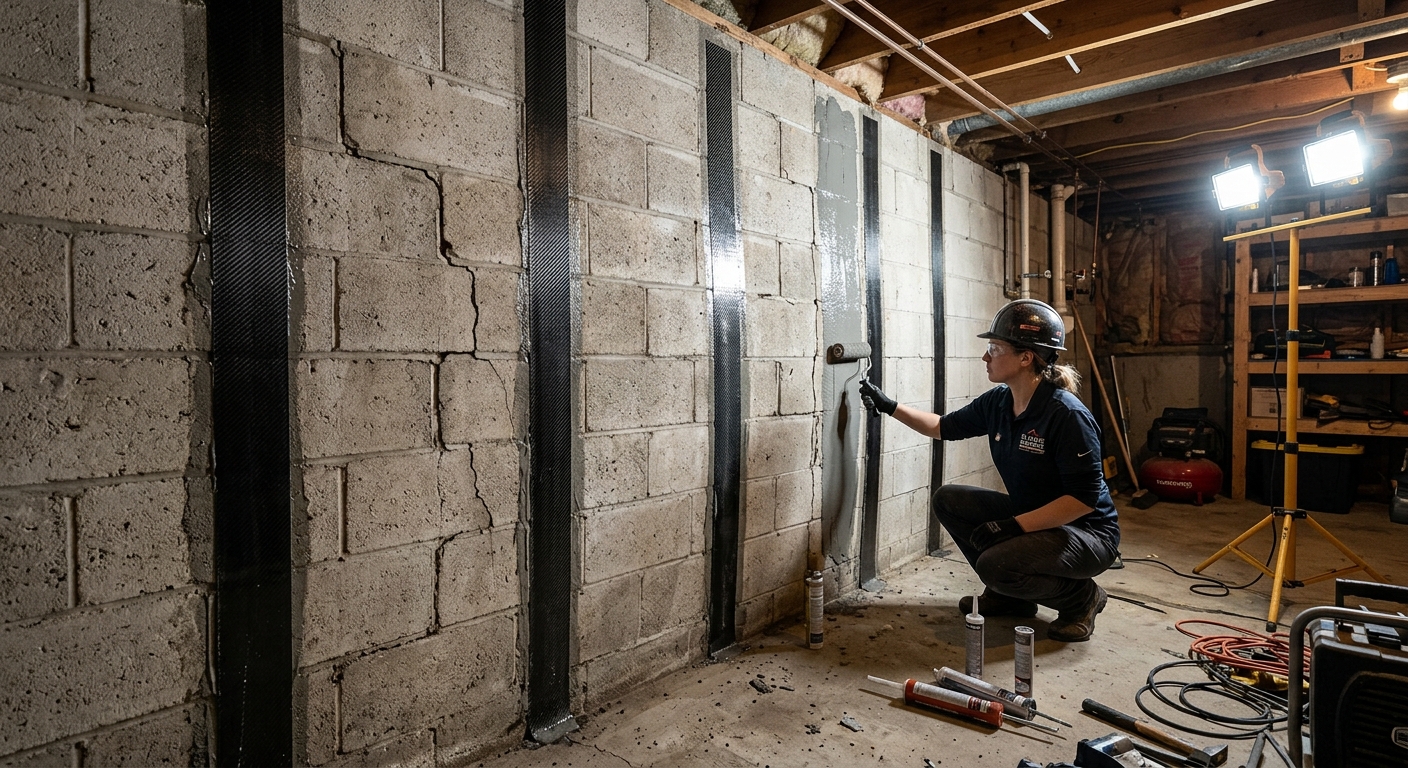
You need basement wall stabilization the moment you see horizontal cracks, inward bowing, or water seeping through your foundation walls. These are not cosmetic issues — they signal active structural failure caused by soil pressure pushing against your basement from the outside. St. Louis homeowners face unique foundation wall stress due to expansive clay soil that swells up to 10% during wet seasons, creating thousands of pounds of lateral force against basement walls built decades ago without modern reinforcement.
- Horizontal or stair-step cracks wider than ¼ inch indicate your wall is flexing under soil pressure
- Visible inward lean of 1 inch or more at the top of the wall — measure from floor to ceiling at multiple points
- Bulging sections in the middle third of the wall where hydrostatic pressure concentrates
- Separation between the wall and floor joists, ceiling, or adjacent walls
- Doors and windows sticking or failing to close properly due to shifting foundation
Don't wait for an inspector to red-flag your foundation during a sale — call our team at (314) 798-9554 for a free structural assessment and written repair plan today.
Horizontal Cracks and Inward Bowing: What They Mean
Horizontal cracks appear when your basement wall can no longer resist the outward push of saturated soil — they're your foundation's way of crying for help. These cracks typically start near the middle of the wall where bending stress is greatest, and they grow wider each year as freeze-thaw cycles and seasonal moisture load continue applying pressure. A horizontal crack wider than ¼ inch means your wall has already moved, and without stabilization, you're looking at progressive failure that accelerates over time.
Inward bowing accompanies horizontal cracks in most cases — your wall is literally flexing like a bow under the weight of soil pressure. Measure the bow by running a string from top to bottom of the wall and measuring the gap at the wall's center. Any bow exceeding 2 inches requires immediate foundation wall repair using anchor systems that counteract soil pressure and prevent collapse. St. Louis clay soil creates some of the highest lateral loads in the Midwest, which is why bowing basement walls are epidemic in our metro area.
How to Measure Wall Movement and Assess Severity
You can assess your basement wall's condition in under ten minutes using a level, measuring tape, and straight edge. Start by checking plumb: hold a 4-foot level vertically against the wall at three points — both ends and center — and measure any gap between level and wall. A gap exceeding 2 inches at the wall's midpoint indicates severe bowing that demands professional foundation wall stabilization within weeks, not months.
Next, measure crack width using a credit card (approximately 3/32 inch thick) or ruler. Cracks wider than the card indicate active movement and structural compromise. Document crack locations and widths with photos and tape measurements — this baseline helps our engineers determine whether wall anchors, carbon fiber, or helical systems will deliver the best long-term repair. Call (314) 798-9554 to schedule your free inspection, and we'll provide an engineer-stamped assessment with measured severity ratings and repair recommendations within 24 hours.
Foundation Wall Anchors: How They Stabilize Bowing Walls
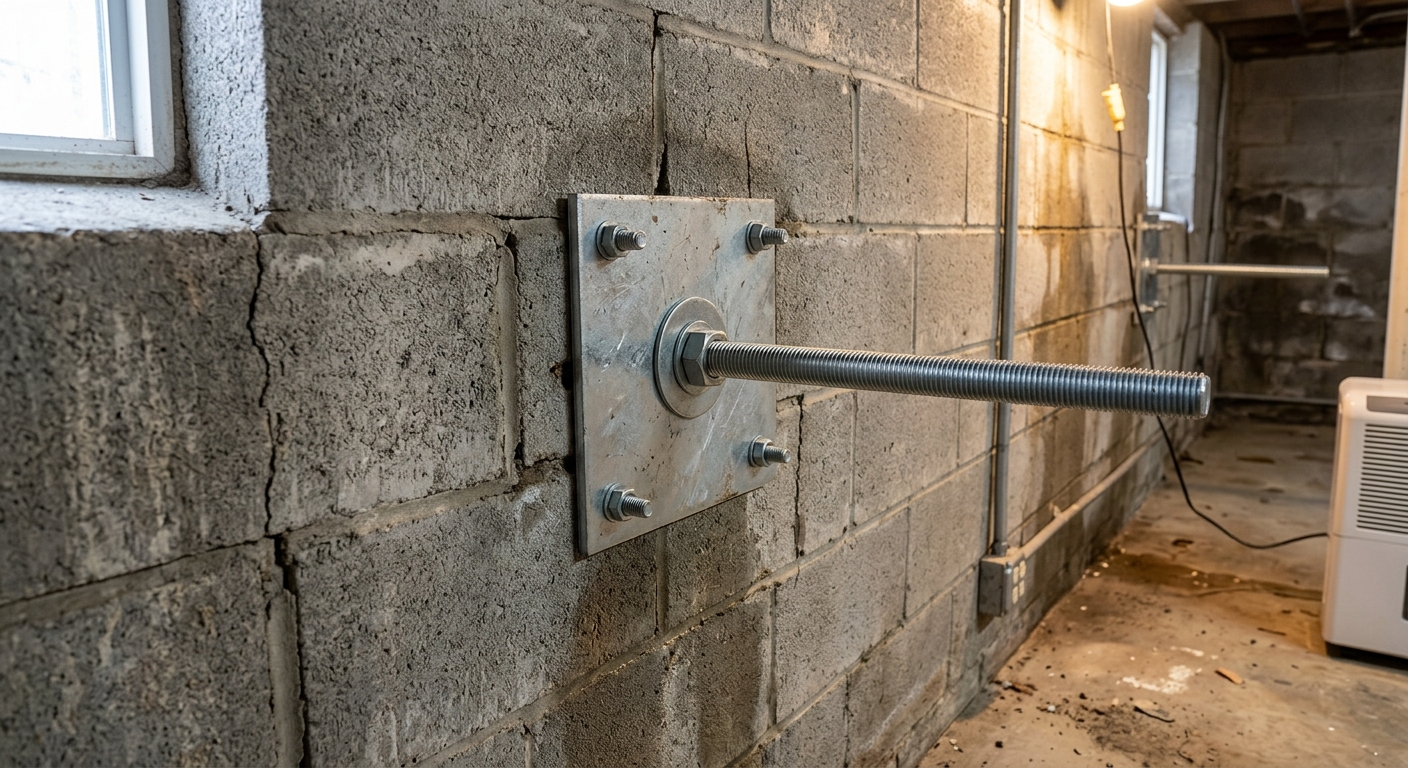
Foundation wall anchors are the gold standard for basement wall stabilization in St. Louis because they counteract soil pressure at its source — outside your foundation. This system uses steel anchor plates buried 10–12 feet beyond your basement wall, connected to interior wall plates by galvanized steel rods that extend through your foundation. When we tighten the interior nuts, the anchor system pulls your wall outward against the soil pressure trying to push it in, creating equilibrium that stops further bowing and allows gradual straightening over time.
- Stops wall movement immediately — the day we install anchors, your wall stops flexing
- Allows seasonal tightening to gradually straighten walls that have bowed 2–6 inches
- Works in any soil condition, including the smectite-heavy clay common throughout St. Louis County
- Transferable lifetime warranty protects your home's value and satisfies inspection requirements
- Minimal interior disruption — anchor plates mount flush against your basement wall
We've stabilized over 500 bowing foundation walls across the St. Louis metro using wall anchor systems, and we back every installation with engineering reports and photographic documentation of measured improvements. Your basement wall repair starts with soil excavation to place exterior anchors beyond the failure zone, followed by rod installation, interior plate mounting, and precision tightening to spec.
How Anchor Plate Systems Work and Prevent Further Movement
Anchor plate systems work by creating a counterforce that opposes the lateral soil pressure pushing your basement wall inward. We excavate narrow trenches 10–12 feet from your foundation wall and install heavy-duty steel anchor plates in undisturbed soil — this is the "anchor" that holds firm while we pull your wall back into position. Galvanized steel rods extend from each exterior anchor plate, penetrate your foundation wall, and connect to interior wall plates mounted against your basement wall.
When we tighten the interior nuts, the rod pulls the wall outward while the exterior anchor resists movement — this creates a tension system that immediately stabilizes your foundation wall and prevents further bowing. The system remains under constant tension, counteracting soil pressure 24/7 regardless of moisture levels or freeze-thaw cycles. This is why wall anchors outperform carbon fiber and other passive systems — they actively push back against the forces trying to destroy your foundation.
Gradual Wall Straightening: Seasonal Tightening for Lasting Results
One of the biggest advantages of foundation wall anchors is their ability to gradually straighten walls over time through seasonal tightening. After initial installation, we schedule follow-up visits during dry seasons when soil contracts and pressure decreases — typically late summer and early winter in the St. Louis climate. During these visits, we tighten the interior anchor nuts an additional quarter-turn, gently pulling your wall outward by 1/8 to 1/4 inch per session.
Over 2–3 years of seasonal adjustments, we can recover 50–80% of severe bowing and completely eliminate minor bows under 2 inches. This gradual approach prevents foundation wall damage from over-correction while maximizing structural recovery. You'll see measurable improvement after each tightening session, documented with before-and-after photos and laser measurements. No other basement wall stabilization method offers this corrective capability — carbon fiber only prevents further movement without straightening existing damage.
Why Wall Anchors Are St. Louis's Most Trusted Stabilization Method
Wall anchors dominate the St. Louis foundation wall repair market because they're the only system proven effective against our region's expansive clay soil and extreme wet-dry cycles. St. Louis sits on smectite-heavy clay that swells up to 10% during spring rains and contracts dramatically during summer droughts — this seasonal expansion creates relentless lateral pressure that passively reinforced walls cannot withstand. Wall anchor systems actively counteract this pressure year-round, regardless of moisture conditions or temperature swings.
Local building inspectors and structural engineers specify wall anchors for any bowing basement wall exceeding 1.5 inches of deflection because they provide measurable, engineer-stamped structural correction. Insurance companies recognize anchor systems as permanent foundation wall repair that restores pre-damage condition, which protects your home's value and insurability. When you're ready to stabilize your bowing foundation walls with the method St. Louis homeowners trust most, call our team at (314) 798-9554 for your free inspection and anchor system quote.
Carbon Fiber Wall Reinforcement: When Straps Are the Right Solution
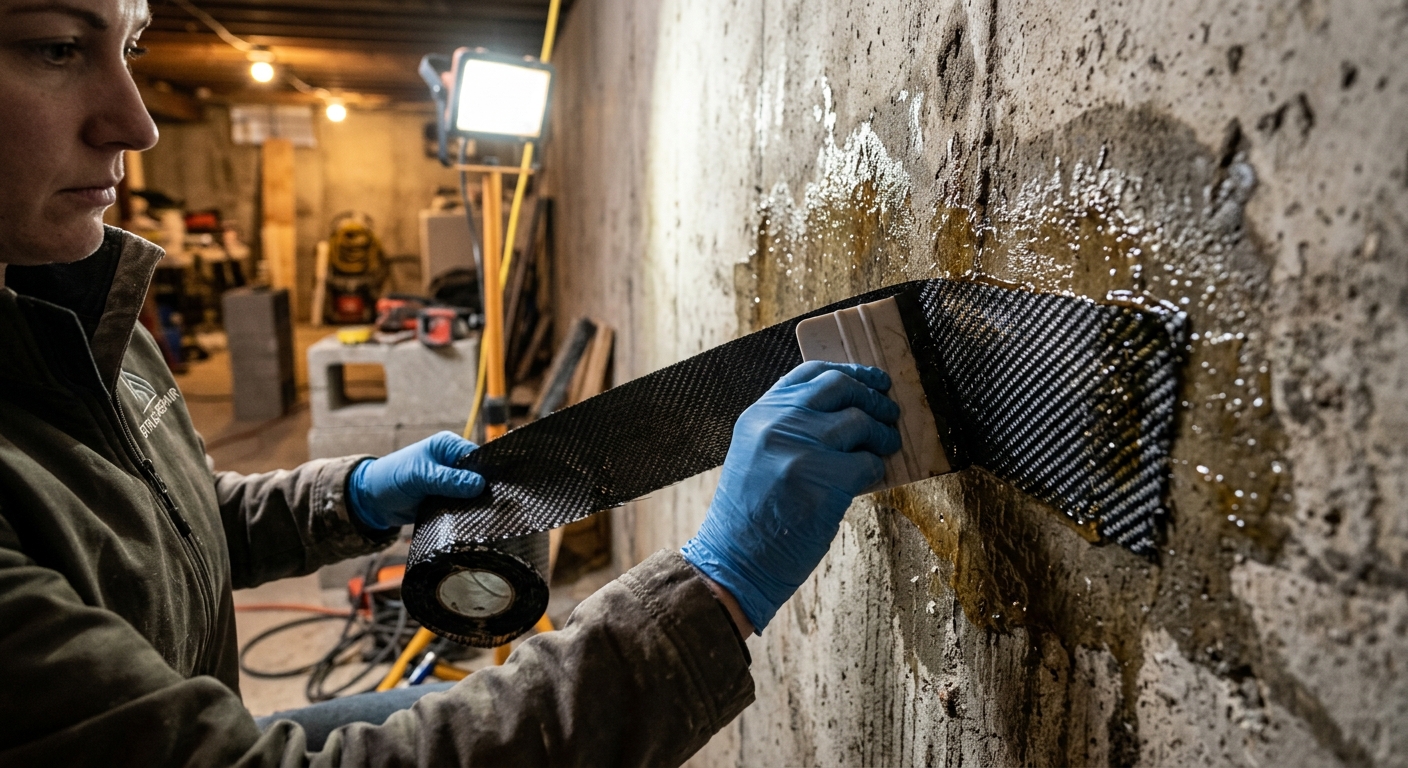
Carbon fiber wall reinforcement uses high-strength composite straps bonded vertically to your basement wall's interior surface, preventing further bowing without exterior excavation or anchor plates. This method works best for minor bowing under 2 inches and horizontal cracks that aren't actively widening — scenarios where you need to lock your foundation wall in place but don't require corrective straightening. Carbon fiber delivers 10,000+ PSI tensile strength in a profile thinner than a credit card, making it the least invasive basement wall stabilization option available.
- No exterior excavation — entire installation happens inside your basement in hours, not days
- Ideal for finished basements where minimizing disruption is critical
- Prevents further inward movement while maintaining your wall's current position
- Lower cost than wall anchors when bowing is minor and soil pressure is moderate
- Can be painted or covered with finishing materials after 24-hour cure time
We install carbon fiber reinforcement on St. Louis basement walls showing early-stage bowing, hairline to ¼-inch horizontal cracks, and situations where soil conditions don't allow anchor plate excavation. Your carbon fiber system includes epoxy-bonded vertical straps spaced 4–6 feet apart, top and bottom mounting brackets, and engineer-stamped load calculations proving the system will prevent further wall bowing under your site's specific soil pressure.
10,000+ PSI Tensile Strength: Why Carbon Fiber Prevents Further Bowing
Carbon fiber's extreme tensile strength — exceeding 10,000 PSI in most commercial-grade products — is what allows thin strips to reinforce entire basement walls. When we bond carbon fiber straps vertically to your foundation wall using structural epoxy, we're essentially wrapping your wall in a steel-strong exoskeleton that resists bending forces. The fiber strands distribute soil pressure across the entire wall surface instead of allowing it to concentrate in weak points, which is how horizontal cracks form in unreinforced concrete.
This tensile strength means carbon fiber reinforcement can handle thousands of pounds of lateral force without stretching, tearing, or debonding from your wall. The epoxy creates a molecular bond stronger than the concrete itself, so failure occurs in the concrete before the carbon fiber gives way. For St. Louis homeowners dealing with moderate soil pressure and early-stage foundation wall bowing, carbon fiber delivers permanent stabilization without the cost and disruption of anchor systems. Just remember: carbon fiber freezes your wall in place — it won't straighten existing bowing like anchors can.
Carbon Fiber vs. Wall Anchors: Which Repair Method Fits Your Foundation
Choosing between carbon fiber and foundation wall anchors depends on three factors: current wall deflection, active movement, and your long-term goals. Use this decision framework to determine which basement wall stabilization method fits your situation best.
Choose Carbon Fiber If: Your wall has bowed less than 2 inches from vertical, cracks are stable and not widening, you want to avoid exterior excavation, and you're okay with preventing further movement without correcting existing bow. Carbon fiber costs 30–50% less than anchors and installs in a single day with zero landscaping disruption.
Choose Wall Anchors If: Your wall has bowed more than 2 inches, you're seeing new cracks or cracks widening over time, you want to gradually straighten the wall back toward vertical, or soil pressure is severe (common in low-lying St. Louis neighborhoods near floodplains). Wall anchors cost more and require excavation, but they're the only system that corrects severe bowing and provides lifetime protection against our region's extreme soil expansion.
Our free inspection includes laser deflection measurements, soil pressure assessment, and side-by-side cost comparison so you can choose the foundation wall repair method that makes sense for your home and budget. Call (314) 798-9554 to schedule your assessment — we'll recommend the right solution based on engineering data, not sales quotas.
Best Use Cases: Minor Bowing and Horizontal Cracks
Carbon fiber wall reinforcement delivers optimal results in three specific scenarios common to St. Louis basements. First: walls showing 1/2 to 2 inches of inward bow with no signs of accelerating movement — this is early-stage foundation wall stress where carbon fiber provides insurance against future failure without the cost of full anchor systems. Second: horizontal cracks under ¼ inch wide that developed years ago but have stabilized — carbon fiber bonds both sides of the crack and prevents widening under future soil pressure.
Third: finished basements where homeowners cannot tolerate exterior excavation, landscape disruption, or multi-day projects. Carbon fiber installs from the interior only, requires no heavy equipment, and allows you to reoccupy your basement the same day. We've successfully stabilized hundreds of St. Louis basement walls using carbon fiber in these exact situations, and every installation includes engineer-stamped documentation and a 25-year warranty against bonding failure. If your foundation wall damage fits these profiles, carbon fiber offers permanent stabilization at a fraction of anchor system costs.
How We Fix Bowing, Bulging, and Leaning Foundation Walls
We fix bowing basement walls using a proven five-step process that starts with engineer-led inspection and ends with documented structural recovery. Every wall bowing foundation repair St. Louis project we complete follows this sequence: free on-site assessment with laser deflection measurement, soil analysis to determine pressure source, custom repair design using either wall anchors or carbon fiber based on your wall's severity, permitted installation by licensed foundation repair specialists, and post-installation monitoring with seasonal follow-up to verify long-term stability.
- Same-day or next-day inspection scheduling — we know foundation wall problems don't wait
- Engineer-stamped assessment report detailing wall deflection, crack width, and soil conditions
- Written quote with itemized pricing, timeline, and warranty terms before work begins
- Licensed installation crew with an average of 12+ years in foundation wall stabilization
- Before-and-after photos with measured deflection recovery documented in your file
Our basement wall repair process addresses both symptoms (cracks, bowing) and root causes (soil pressure, drainage failure) so your foundation wall stays stable for decades after we leave. Most installations complete in 1–3 days depending on anchor count or carbon fiber length, and we restore your yard to pre-project condition as part of every excavation-based repair.
The Complete Repair Process: Inspection Through Installation
Your basement wall stabilization project begins with a comprehensive inspection where our foundation repair specialist measures wall deflection at multiple points, documents crack patterns with photos and diagrams, and evaluates exterior grading and drainage conditions that contribute to soil pressure. We use laser levels to measure deflection accurate to 1/16 inch, which establishes your baseline and helps us track recovery after repair. This inspection data feeds directly into our engineer's structural analysis, which determines whether your wall needs anchors, carbon fiber, or a hybrid approach.
Once you approve the written quote, we schedule installation and pull required permits — all foundation wall repairs in St. Louis require permits to ensure compliance with structural codes. For wall anchor systems, we excavate 12-inch-wide trenches 10–12 feet from your foundation, install exterior anchor plates in undisturbed soil, drill through your basement wall at predetermined anchor locations, and mount interior wall plates connected by galvanized steel rods. We tighten each anchor to engineer-specified torque, backfill excavations, and schedule your first seasonal tightening appointment. Carbon fiber installations involve surface prep, epoxy application, strap placement, and 24-hour cure time. Every project concludes with a final walkthrough, warranty paperwork, and your engineer-stamped completion certificate.
Bulging vs. Bowing: Understanding Your Foundation Wall Problem
Bulging and bowing describe different types of foundation wall deflection that require the same stabilization solutions but indicate different failure patterns. Bowing refers to a smooth, consistent inward curve running the full height of your wall — picture a sheet of plywood flexing under weight. Bulging describes localized outward or inward swelling, usually in the wall's center third where soil pressure and hydrostatic force concentrate. Both indicate your wall is losing the battle against lateral soil pressure, and both demand immediate basement wall stabilization to prevent
Frequently Asked Questions
Are you a member of any professional foundation repair organizations?
Yes, reputable foundation repair companies in St. Louis should maintain memberships with organizations like the National Association of Waterproofing and Structural Repair Contractors (NAWSRC) or local builder associations. These memberships require adherence to industry standards and continuing education. When hiring for basement wall stabilization, always verify a contractor's credentials, ask for proof of membership, and confirm they carry proper licensing and insurance for work in Missouri. Professional affiliations demonstrate commitment to quality workmanship and staying current with the latest foundation repair techniques.
How much does basement wall stabilization cost in St. Louis?
Basement wall stabilization costs in St. Louis typically range from $4,000 to $15,000 depending on wall length, severity of bowing, and repair method chosen. Wall anchor systems usually cost $400 to $600 per anchor, with most basements requiring 5 to 8 anchors. Carbon fiber reinforcement runs $200 to $400 per linear foot for moderate bowing. Steel I-beam installation costs more at $500 to $800 per beam. Foundation repair St. Louis MO contractors provide free inspections to assess your specific situation and recommend the most cost-effective solution for your bowing or bulging basement walls.
What causes basement walls to bow or bulge in St. Louis homes?
St. Louis basement walls bow primarily due to hydrostatic pressure from clay-heavy soil that expands when saturated with groundwater. The region's freeze-thaw cycles worsen the problem as moisture in soil expands when frozen, pushing against foundation walls. Poor drainage, clogged gutters, and inadequate grading direct water toward foundations, increasing pressure. Older homes built before modern waterproofing standards are especially vulnerable. Signs include horizontal cracks, walls leaning inward at the top, and separation between walls and floor joists. Addressing bowing basement walls quickly prevents catastrophic failure and costly structural damage.
What is the difference between wall anchors and carbon fiber for foundation wall repair?
Wall anchors physically pull bowing foundation walls back toward their original position using steel plates installed inside the basement connected to earth anchors buried in stable soil outside. This system works for severe bowing and can actually straighten walls over time. Carbon fiber reinforcement uses high-strength fabric strips epoxied to walls to prevent further movement but cannot reverse existing bowing. Carbon fiber costs less and requires no exterior excavation, making it ideal for walls with less than 2 inches of deflection. Foundation wall anchors handle more severe bulging and provide adjustability to gradually improve wall position over months or years.
How long does basement wall stabilization last?
Properly installed basement wall stabilization systems in St. Louis last the lifetime of your home when installed by qualified foundation repair contractors. Wall anchor systems carry 25-year to lifetime transferable warranties and use galvanized steel components resistant to corrosion. Carbon fiber reinforcement maintains its tensile strength indefinitely when protected from UV exposure and physical damage. Steel I-beams also provide permanent stabilization. The key to longevity is addressing underlying water issues through proper drainage, downspout extensions, and waterproofing. Most foundation repair St. Louis MO companies offer comprehensive warranties covering both materials and workmanship for decades.
Do you serve all areas of St. Louis including St. Charles and Jefferson County?
Most established foundation repair companies serve the greater St. Louis metropolitan area including St. Louis City, St. Louis County, St. Charles County, Jefferson County, and surrounding communities. Service areas typically extend to O'Fallon, Chesterfield, Kirkwood, Webster Groves, Florissant, and Arnold. Because bowing basement walls require specialized equipment and experienced crews, verify your foundation contractor regularly works in your specific area and understands local soil conditions. Companies familiar with Missouri clay soil and regional building codes deliver better results. Always request references from projects completed near your location before committing to basement wall stabilization work.
How quickly can you respond to a bowing basement wall emergency in St. Louis?
Reputable foundation repair contractors in St. Louis typically schedule free inspections within 2 to 5 business days for non-emergency situations. For severe bowing showing rapid progression, horizontal cracking wider than a quarter inch, or visible wall movement, many companies offer emergency assessment within 24 to 48 hours. Actual repair installation usually occurs within 1 to 3 weeks after inspection depending on scheduling and material availability. Emergency temporary stabilization can sometimes be arranged within days for walls at risk of failure. Contact multiple foundation repair St. Louis MO specialists immediately if you notice sudden changes in wall position or new structural cracks.
Are foundation repair companies licensed and insured in Missouri?
Missouri does not require a specific foundation repair license, but legitimate contractors carry general liability insurance with minimum coverage of $1 million and workers compensation insurance for all employees. Verify your foundation repair St. Louis MO contractor provides certificates of insurance before work begins. Many reputable companies also maintain bonding and hold voluntary certifications from manufacturer training programs for wall anchor and carbon fiber systems. Ask for proof of insurance, check references, verify business registration with Missouri Secretary of State, and confirm the company has an established local address and history serving the St. Louis area before hiring for basement wall stabilization.
Book your free foundation inspection
Tell us what you are seeing and where the home is. The inspection is free, there is no obligation, and you get a written estimate showing the repair method, the number of piers or anchors and the total before anything is scheduled.